Automating the Series A Metrics Stack Inside Supabase With Agentic SQL Pipelines
Pre-modeled Postgres metrics and fenced-in agents can keep Series A numbers defensible.
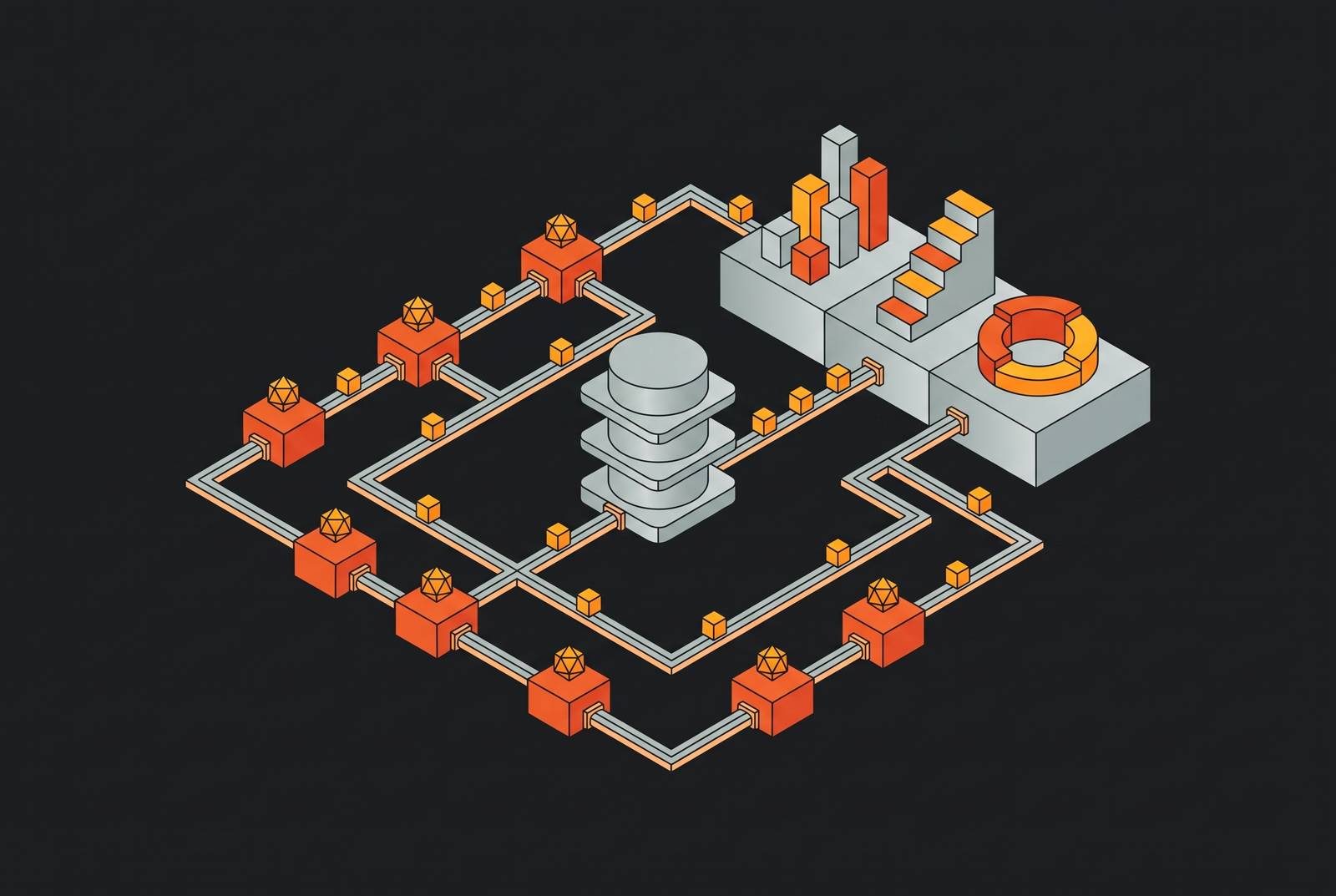
Analytics for Supabase teams should pre-calculate investor metrics in Postgres, isolate analytical work from production, and expose governed definitions to both dashboards and AI agents. Agentic SQL pipelines can maintain that stack without a dedicated data team, provided their access and repair actions are constrained. The foundation is not unrestricted natural-language SQL, but stable metric models that remain defensible through a Series A fundraise.
Why Supabase founders hit a metrics wall before Series A
Supabase Postgres is both the application’s transactional backbone and the most accessible place to answer business questions. That convenience creates a workload conflict as analytical queries grow. Long-running aggregations and live traffic need the same connection slots, while lock contention on hot tables can get in the way of writes. A well-tuned PgBouncer still has a connection limit.
The numerical failures are less visible than slow requests. Different queries can return different MRR, churn, or active-user counts because each embeds a different definition. Without cohort structure, top-line reporting also lacks the data investors use to reconstruct retention independently. The data room exposes both weaknesses at once. Burn multiple, NRR, CAC payback, and ARR growth require agreed definitions across billing, CRM, and usage data, making this an architectural problem.
What investors actually check in the Series A data room
Net Revenue Retention requires expansion and contraction tracking for an established customer cohort. CAC payback connects acquisition-channel attribution to revenue and gross margin. Burn multiple divides net burn by net new ARR, so finance and billing must reconcile over the same period. Year-on-year ARR growth needs the same revenue definition for each period. These are related calculations, but they answer different questions about the business.
Cohort retention by acquisition channel supplies the supporting data. Investors can reconstruct that chart from raw data, so the founder’s model must survive the same exercise. Definitions must precede the partner meeting. Benchmark comparisons are useful only when the underlying calculation is stable enough to compare, rather than assembled from exports with incompatible dates or customer identifiers.
When finance waits for RevOps to export pipeline information, the forecast can already be outdated before submission. A queryable source joining CRM, billing, and usage removes that handoff from the calculation. Finance still needs ownership of the definitions. Automation cannot resolve a disagreement about what counts as recurring revenue or net burn.
Why Postgres is the right analytical home for these metrics, not a warehouse
For this metrics stack, Postgres already supplies the necessary analytical primitives, including window functions, CTEs, materialized views, and row-level security. Keeping the models there avoids introducing a separate warehouse schema and extraction pipeline merely to calculate investor metrics. Joins can follow the application’s data structure. There is less synchronization machinery to maintain.
The safe design separates transactional and analytical execution through a read replica or governed analytical copy. Materialized views pre-calculate complex aggregations so subsequent requests read the computed results. Refresh work runs in the writable analytical environment, while queries use read-only replicas to stay apart from that work. Freshness still depends on replication and refresh timing. Staying in Postgres avoids an additional warehouse synchronization step.
For delivery beyond Postgres, governed Parquet datasets can hold the pre-calculated results. DuckDB can query those exports without having to touch production. This extends workload isolation to human dashboards and agent requests rather than making each consumer another database client. Postgres remains the home of metric definitions. The export is a delivery format.
The observability layer Supabase projects need before metrics pipelines can run reliably
At query level, pg_stat_statements helps identify slow statements, execution frequency, and the cost of metric calculations, while refresh monitoring establishes whether scheduled work finishes. Connection monitoring shows active sessions, waits, and remaining pool capacity. Active connections need attention when they rise above 80% of the maximum. System monitoring adds CPU, memory, IO, and replication lag, which directly limits the freshness of replica-derived metrics.
Supabase-specific signals include Realtime channel count, Edge Function cold start latency, and PgBouncer pool utilization. Structured logging and Prometheus metrics provide the infrastructure for interpreting those signals over time. This is not merely dashboard instrumentation. The pipeline needs diagnostic data that distinguishes a failed refresh from a slow replica or an exhausted pool before choosing a response.
How agentic SQL pipelines automate metric calculation without a data team
An agentic pipeline takes over recurring scheduling, diagnosis, and repair work through a constrained observe, reason, act, and learn loop. Its intent layer specifies the metrics, consumers, and freshness SLAs. Its observability layer tracks pipeline health, schema drift, data quality, and missed SLAs. Those signals guide the reasoning engine’s diagnosis. The engine then selects a response rather than treating every failure as a reason to retry.
The action layer executes permitted responses, including restarting a refresh, isolating a faulty data segment, or scaling a read replica. Memory records incidents, decisions, and outcomes so recurring problems do not require the same investigation each time. Governance determines which actions run automatically and which require approval. Every decision must be logged. An agent needs clear limits on what it can do on its own, even if it can write plausible SQL.
For example, an NRR refresh can fail after an upstream billing column is renamed. The pipeline detects the failure and identifies schema drift as its cause. A permitted repair updates the affected definition and reruns the refresh in the analytical environment using the isolated source. Otherwise, it requires human approval. A record of the change and how it worked gives the memory layer a past repair to draw on, while future edits still need permission.
Eshun et al.’s reference architecture shows how components that already exist can work together in a self-healing loop that people can trust and oversee. Natural-language-to-SQL serves a different purpose. It can support exploration, but investor metrics need pre-modeled calculations whose meaning does not change when a question is phrased differently.
The access pattern that keeps agents away from production
The first boundary is a Postgres role that grants only the access needed for the task. Read-only access blocks writes, but it can still let an agent see more than it needs. The pg_read_all_data role grants broad read access without write capability. Scoped roles are the better fit for curated exposure. An agent that uses metrics needs permission to read them without also gaining access to every table behind them.
The second boundary is the database endpoint. Analytical and agentic reads target a replica or governed analytical copy rather than the production primary, protecting primary connection headroom and separating queries from production writes. The third boundary is the exposed data surface. Curated views, record-level authorization, and sensitive-field redaction determine what consumers can see. Tool rules keep those limits in place outside the model, even when text read from the database contains untrusted instructions.
Repairing definitions or taking write-adjacent actions requires the governance layer’s approval rules and action limits. The MCP server can enforce the consumer-facing boundary by querying governed datasets. Agents consume approved definitions through that interface. Their promises about safe behavior are not part of the access control.
Modeling the five metrics that define a Series A-ready Postgres schema
The governed layer starts with MRR calculated from subscription events, with amounts normalized to a month. Its staging layer should preserve event history independently of mutable application rows. An illustrative SQL sketch is SELECT customer_id, billing_month, SUM(monthly_amount) AS mrr FROM subscription_events GROUP BY customer_id, billing_month. Here, monthly_amount is an amount that has already been normalized, and the sketch assumes staging has used the event history to build the monthly records for the calculation. It is not a complete billing implementation.
NRR builds on that customer-month structure. A cohort model groups customers by first billing month and retains their starting MRR. An illustrative join is SELECT c.cohort_month, m.billing_month, SUM(m.mrr) / NULLIF(SUM(c.starting_mrr), 0) AS nrr FROM cohort_customers c JOIN customer_month_mrr m ON m.customer_id = c.customer_id GROUP BY c.cohort_month, m.billing_month. The join key preserves cohort membership across periods. The customer-month input must include zero MRR after churn so disappearing customers do not disappear from the denominator, and expansion and contraction remain separately modeled.
CAC payback joins acquisition information, including UTM parameters or referral source, to first invoice date and cumulative gross margin through customer ID. The channel attribution rule belongs in the view definition. Burn multiple joins the billing model to finance_entries, where cash out is recorded, using net burn and net new ARR for the same period. Its net-burn definition needs agreement before automation. The same monthly revenue history also lets teams calculate year-on-year ARR growth using the same revenue definition.
The fifth model is cohort retention by acquisition channel, expressed as a cohort × period matrix with channel as a dimension. A materialized view makes that chart available on the agent-managed refresh schedule. Every metrics view needs a comment with its definition, which source tables it uses, its refresh schedule, and who owns it. That dictionary anchors explanations as well as calculations. An append-only or event-sourced staging layer preserves the history needed to prevent backfilled application data from silently rewriting earlier metrics.
How do you get analytics and dashboards for your Supabase project through a single MCP server?
A single MCP server exposes the governed metrics layer to human-facing applications and AI agents. It can query pre-calculated Parquet datasets through DuckDB, leaving production Postgres outside the request path. Choosing a dashboard then depends on whether it can use approved definitions, show how fresh the data is, and enforce authorization, as well as connect directly to the database. A direct connection alone proves very little. The useful connection is one that serves the agreed calculation without competing with application traffic.
This is headless analytics in practical terms. The governed backend is independent of the interface, so a live dashboard, weekly email, investor summary, and Slack answer can use the same metric dataset. None needs to define NRR again. An agent calling the NRR endpoint receives the approved calculation for the requested cohort and period, rather than inventing a query from its interpretation of the question. Results remain traceable to the definition and refresh state that produced them.
The 2026-07-28 MCP specification makes the protocol layer stateless, allowing requests to reach any server instance behind a standard load balancer. As more agents use it, that lets the system scale horizontally without custom code to manage protocol sessions. Access control remains a separate responsibility. The server still has to enforce the governed layer’s permissions regardless of which instance handles a request.
What a founder gains when agents run the metrics stack instead of maintaining it
The fundraise benefit is a set of numbers that can withstand reconstruction. A finance export and investor deck can use the same NRR definition, while the acquisition-channel cohort chart is already available. Freshness becomes explicit. When a schema change breaks a calculation, the pipeline can find the failure and make an approved repair before queries that disagree spread through reporting.
For a founder starting on Monday, the first task is query and workload instrumentation through pg_stat_statements and the surrounding connection and system signals. The second is separating analytical reads from production through a read replica or governed analytical environment. The third is modeling the five core metrics with locked definitions and documented ownership.