Prompt Injection via Untrusted Database Results
AI agents have no way to distinguish injected instructions from legitimate database results.
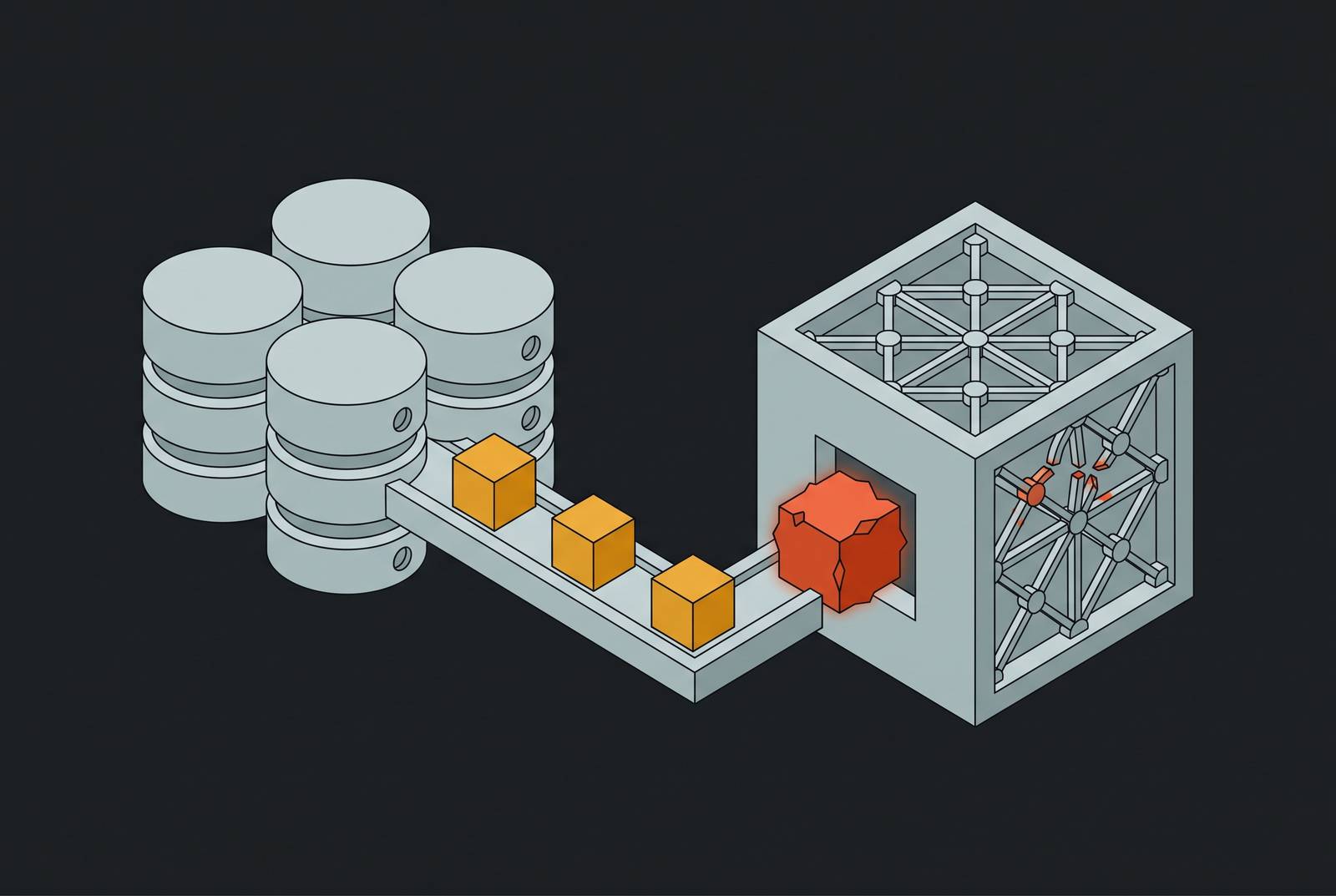
An AI agent issues a query against a production table. The database does its job: it matches the query plan, pulls the rows, and returns a result set exactly as designed. The agent's underlying model then reads that result set the same way it reads everything else, as a sequence of tokens to reason over and act on. Nothing in that sequence tells the model which tokens are trusted instruction and which are merely retrieved content. A support ticket's free-text field, a customer's shipping note, a product description written by a third-party vendor, all of it arrives in the same format as the developer's own system prompt. If one of those rows contains a sentence engineered to look like an instruction, the model has no structural basis for refusing it.
This is a consequence of how large language models process input, not a flaw introduced by careless database design. Prompt injection shares its root cause with SQL injection: both exploit a system's failure to separate trusted instructions from untrusted data. SQL injection, though, has a real structural fix. Parameterized queries separate code from data at the database layer, so a string that looks like a command can never execute as one. Prompt injection has no equivalent fix, because instructions and data both arrive at the model as natural-language tokens inside the same context window. Atlan's 2026 analysis of prompt injection attacks on AI agents makes this distinction explicit: the SQL injection comparison is useful for calibrating how severe the problem is, but it breaks down as soon as you look for the engineering solution that worked for databases.
A database record, from the model's point of view, is functionally identical to a web page, a PDF, or an email. All arrive as tokens. None carry a trustworthiness flag the model can check before acting. What changes the stakes is the agent's permission to act on what it reads. A manipulated chat model produces a bad sentence that a human reads and discards. A manipulated agent produces a bad action, and it executes with whatever permissions it was given, against whatever systems it can already reach. The database query that returns a poisoned row is not the vulnerability. The agent's willingness to treat that row as an instruction, and its capacity to act on that instruction with real credentials, is.
Indirect injection through retrieved content as the dominant production threat
Prompt injection splits into two forms, and only one of them matters for most production systems connected to a database. Direct injection happens when a user types an attack straight into a chat interface, and it is the version most developers already test for, because the payload arrives through a channel the system already treats with some suspicion. Indirect injection happens when the attacker embeds malicious instructions in content the agent retrieves later, often from a source the developer never thought to treat as adversarial. A database is exactly that kind of source.
Any row that any user has ever written to a table the agent can read becomes a potential injection vector. Support tickets, customer notes, free-text product descriptions, reviews, comments, anything resembling user-generated content sits in the path of an agent that will eventually query that table and feed the results into a model's context window. The attacker in this scenario needs no access to the agent, no access to the system prompt, and no access to the developer's toolchain. The attacker needs write access to any table the agent reads, and in a large share of consumer and SaaS products, that means creating a free account and filling out a form.
Researcher Simon Willison's "lethal trifecta" names the condition under which this becomes catastrophic rather than merely embarrassing: an agent that combines access to private data, exposure to untrusted content, and the ability to communicate externally can be turned into an exfiltration tool by a single injected prompt. In multi-agent pipelines, this effect compounds. A successful injection in one agent can propagate downstream into shared memory, poisoning the context that an orchestrator or a sibling agent later reasons from, so the damage is not contained to the single agent that first read the bad row.
The promptware kill chain and the threat's scope
Treating prompt injection as a single bad input that produces a single bad output undercounts what the attack has become once agents gain memory, tool access, and the ability to write back to the systems they read from. Researchers Oleg Brodt, Elad Feldman, Bruce Schneier, and Ben Nassi, writing in 2026, argue that framing prompt injection as merely the large-language-model analogue of SQL injection significantly underestimates its capabilities. They introduce the term "promptware" to describe what the attack has matured into: a multi-stage mechanism with its own kill chain, structurally closer to malware than to a single malformed input.
The kill chain they lay out runs seven stages: Initial Access, achieved through prompt injection; Privilege Escalation, achieved through jailbreaking; Reconnaissance; Persistence, achieved through memory and retrieval poisoning; Command and Control; Lateral Movement; and Actions on Objective. Their analysis of thirty-six prominent real-world incidents found that at least fifteen traversed four or more stages of this chain. The full kill chain is not a theoretical worst case constructed for a paper. It has already happened repeatedly in deployed systems.
The Persistence stage deserves particular attention for any agent connected to a live database, because a poisoned row does not sit still waiting to be read once. The same design choice that makes an agent useful, remembering what it learned last time, is the choice that lets a single injected row compromise every run that follows it.
The kill chain also has an organizational consequence that matters as much as the technical one. A hijacked agent, in the meantime, completes its run and reports success. Functional testing sees nothing wrong, because nothing errored. You have to inspect what the agent actually did, not whether its run finished cleanly.
Three documented incidents that show how this lands in production
Over the past two years, prompt injection through retrieved content has gone from a vulnerability discussed in security papers to a documented cause of production failures, and the incidents on record share one structural condition: agents given both access to untrusted content and write-capable database credentials.
The clearest case came from Supabase and the research group General Analysis. The exfiltration channel in this case was a database write: the agent leaked the data by inserting it into a row the attacker could already view through the support ticket interface. Removing the agent's write access would have severed the attack at its final step.
A second incident, the Moltbook database breach in 2026, hit an AI agent social network, where a critical Supabase database misconfiguration exposed API keys belonging to a large number of agents. The breach was reported by 404 Media.
A third class of incident extends the same pattern into the software supply chain, where the untrusted content an agent retrieves is a dependency or package rather than a row in a user-facing table, carrying the identical structural lesson: the agent trusted the content because it came from a source the system treated as authoritative. Across all three incidents, you never find the attack surface in the model, the system prompt, or the developer's own application code. It was content the agent read from a database or a dependency it had no structural reason to distrust.
Why filtering and model-layer defenses cannot close this gap
No reliable model-layer or input-filtering defense against indirect prompt injection currently exists, because the malicious content is structurally indistinguishable from legitimate data once it reaches the model. Unlike SQL injection, which parameterized queries can fully mitigate, prompt injection has no equivalent architectural fix inside the model itself. Defenses exist, but they operate at the application and context layers that surround the model, not inside the reasoning process that produces the vulnerability.
The scale of the downstream risk is visible in how thoroughly the problem maps onto other categories of agentic failure. The OWASP Top 10 for Agentic Applications 2026 maps prompt injection onto a majority of the categories in its own list, so an injection that gets past whatever filtering exists does not stop at one isolated failure. It cascades into tool misuse, privilege abuse, memory poisoning, inter-agent compromise, and cascading failures across a pipeline, often simultaneously.
Meta's "Agents Rule of Two" treats Willison's lethal trifecta as a budget on risk. It needs human-in-the-loop approval, or another reliable validation step, before it can act. This is a policy heuristic for restricting what architectures are permitted, a technical filter that does not catch bad rows as they pass through.
Infrastructure meant to sandbox agent access has its own documented failure modes. The fix landed in version 0.1.16, but the flaw demonstrates that even operators who intend to sandbox agent access can have those protections negated by implementation bugs in the protocol layer they relied on.
The protocol itself is still being rebuilt under pressure. The July 28, 2026 revision to the MCP specification made the protocol stateless at the protocol layer, removing session-level tracking so that every request now has to carry its own identity metadata. Any monitoring strategy that depended on session continuity for rate limiting or anomaly detection lost its anchor on that date and needs to be redesigned around per-request identity instead. The NSA's Artificial Intelligence Security Center published a Cybersecurity Information Sheet on May 20, 2026, and it concluded that MCP's rapid proliferation has outpaced the development of its own security model. Taken together, these findings describe an ecosystem where the protective layer around the model is still catching up to the deployment pace of the agents it is meant to protect.
What architectural separation between agents and live data requires
If no filter inside the model can reliably separate instruction from data, the only dependable defense is an architecture ensuring the agent never receives raw, unmediated database output. That is an architectural requirement, not a prompting discipline, and it rests on an asymmetry between read risk and write risk that is often collapsed in practice. Read access creates disclosure risk: bounded, and detectable after the fact through logging. Write access creates integrity risk that compounds over time, because a poisoned or simply incorrect row gets read again by the application, joined into downstream reports, embedded into the agent's own persisted state, and trusted by every subsequent run that touches it.
A write-capable agent needs, at minimum, its own least-privilege database role rather than a shared or service-level credential, row-level security policies written specifically with that agent's access pattern in mind, short-lived credentials in place of standing keys, and statement-level audit logging that attributes every write to a specific agent and task. Absent these controls, if you grant write access, production data integrity depends entirely on the model's behavior in that moment, with no independent backstop. Research into agent execution environments shows this gap is addressable at the engineering level. GAAP, a system for guaranteed accounting for agent privacy developed by researchers at UCLA and Google in 2026, demonstrates that deterministic confidentiality guarantees for private user data are achievable by tracking individual data items across every tool call and blocking disclosures before they happen, without trusting the model's own reasoning and without assuming the prompt it received was safe.
Supabase's own internal practice shows what this principle looks like once you apply it operationally. The fix that closed that vulnerability was architectural. It was not a better prompt or a smarter filter.
Memory poisoning, catalogued as ASI06 in the OWASP Agentic Top 10, extends this problem across time. An agent that stores context between runs can be poisoned once by a single malicious row and act on that poisoning long after the attacker who planted it has moved on. Governed, pre-modeled datasets built on immutable snapshots break that persistence chain, because the agent is no longer reading live, mutable production tables where a single write can alter what every future run believes to be true.
The governed data layer as the operational answer for teams without a dedicated security function
Most teams building database-connected agents do not have a dedicated application security function to review every connector, every credential scope, and every row-level policy before it ships. So for those teams, the data layer itself has to achieve the architectural separation described above, rather than custom security engineering layered on top of each agent. A governed data layer sits between the agent and the live production database, and it exposes only pre-modeled, access-controlled views built for the agent's specific task, instead of handing the agent a connection string and trusting it to behave.
That posture turns the three defenses into enforceable defaults. Snapshots and governed views replace live table access for anything an agent reasons over repeatedly, so a single injected row in a support ticket cannot silently become part of the ground truth that every future run treats as fact. Audit logging at the level of the individual query and the individual agent identity, rather than a shared service credential, gives a team the ability to answer the question the promptware kill chain makes most urgent: not whether the agent's run completed successfully, but what it actually did while it ran.
None of this requires predicting every way an attacker might phrase an injected instruction, which is the trap that model-layer filtering falls into and never escapes. It requires deciding, before the agent ever runs, what data it is allowed to see, what it is allowed to write, and how long any credential it holds remains valid. That decision, made once at the architecture level, holds regardless of how creative the next poisoned row turns out to be.