Agentic Product Analytics Pipelines That Treat Supabase Postgres as the Instrumentation Layer
Replicate Supabase data, model metrics once, and let agents read safely.
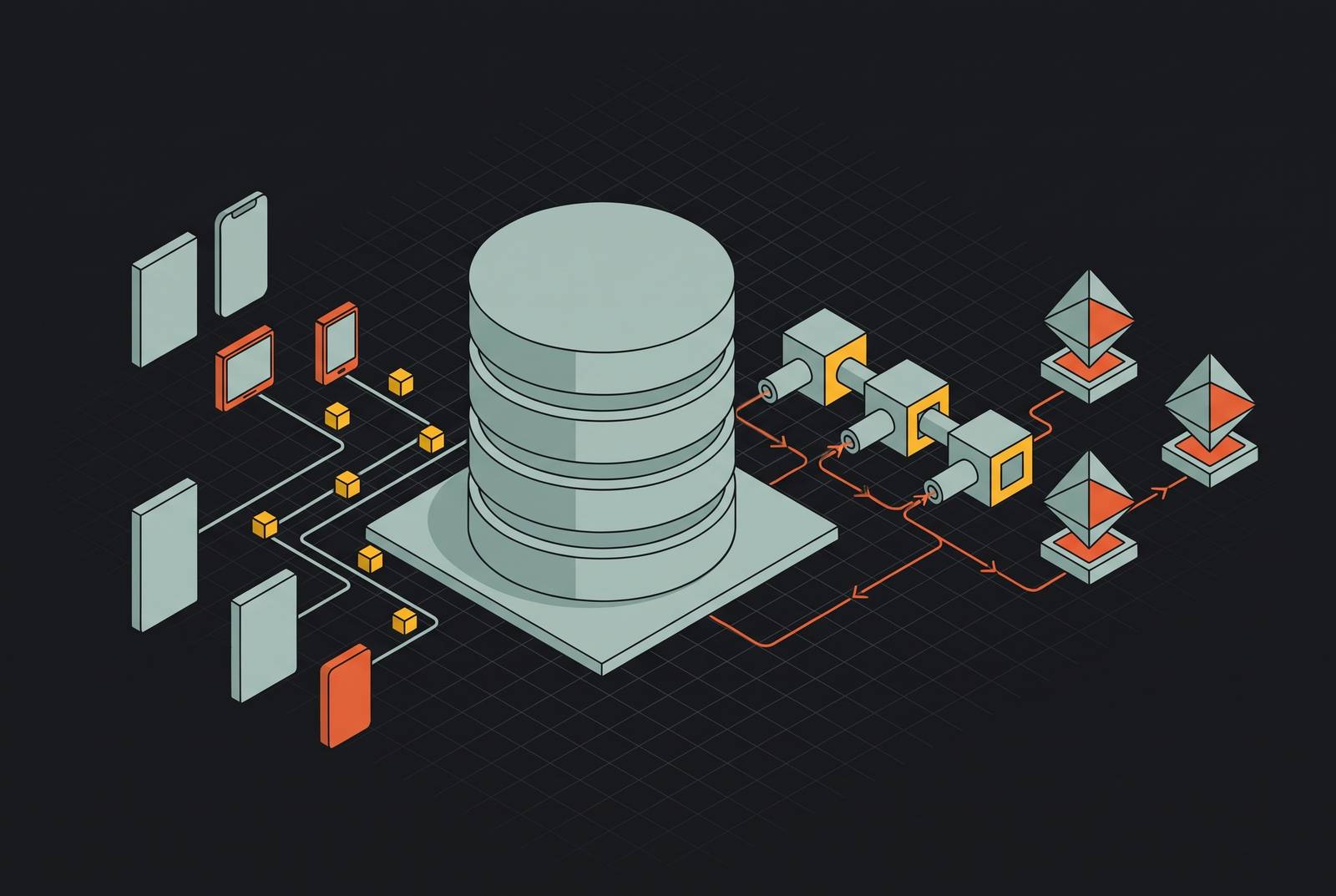
For Supabase teams, agentic product analytics should start with the data already in Postgres. The safe architecture replicates those signals into an analytical store, models them into governed, pre-calculated datasets, and exposes them through a read-only MCP interface. Agents and dashboards use defined metrics without sending analytical queries to the production primary.
Why Supabase Postgres already contains everything product analytics needs
Supabase Postgres already holds the events, entities, and relationships needed to understand much of a product’s behavior. Auth events show who had access, row-level inserts show what they did, and foreign keys link those actions to users and sessions. The behavioral signals are already being captured. For example, auth events, a user table, and a JSONB activity column together provide both activity records and the relational context needed to interpret them. Those records already hold the signals, so there is no need for a separate event-tracking SDK to get them.
That existing context makes Postgres more than a collection of isolated events. An action can be understood in relation to the user or session that produced it. The pipeline’s starting point is therefore the application’s existing data model. Its job is to turn those operational records into analytical definitions, while preserving the relationships that give them meaning.
Why running analytics queries directly on that production Postgres is an architectural mistake
Production Postgres handles work for users, while complex analytical queries compete for the resources that work needs. The contention can be severe under analytical load. Supabase’s documentation describes a test in which the most complex analytical query caused 90% of read operations to fail, illustrating why analytical reads can be routed to a replica while the Primary handles create, update, and delete operations.
Queries from agents make that competition harder to predict. An agent querying production on demand can introduce load spikes, encounter row-level security constraints, and collect live-state snapshots that do not form a consistent analytical view across requests. This is not simply a query-performance problem. The agent also becomes responsible for interpreting permissions and changing data while answering a business question, mixing operational concerns with metric calculation.
Analytics Buckets provide a specialized columnar bucket type within Supabase Storage, while Pipelines moves production data into analytical destinations. Both keep analytical work out of the production query path. High-volume activity streams also need care when they are captured, because subscriptions to tables with heavy insert traffic can overload Realtime WAL processing. Postgres Changes is intended for moderate-volume user-facing data.
What the correct pipeline architecture looks like with instrumentation, modeling, and agent access separated
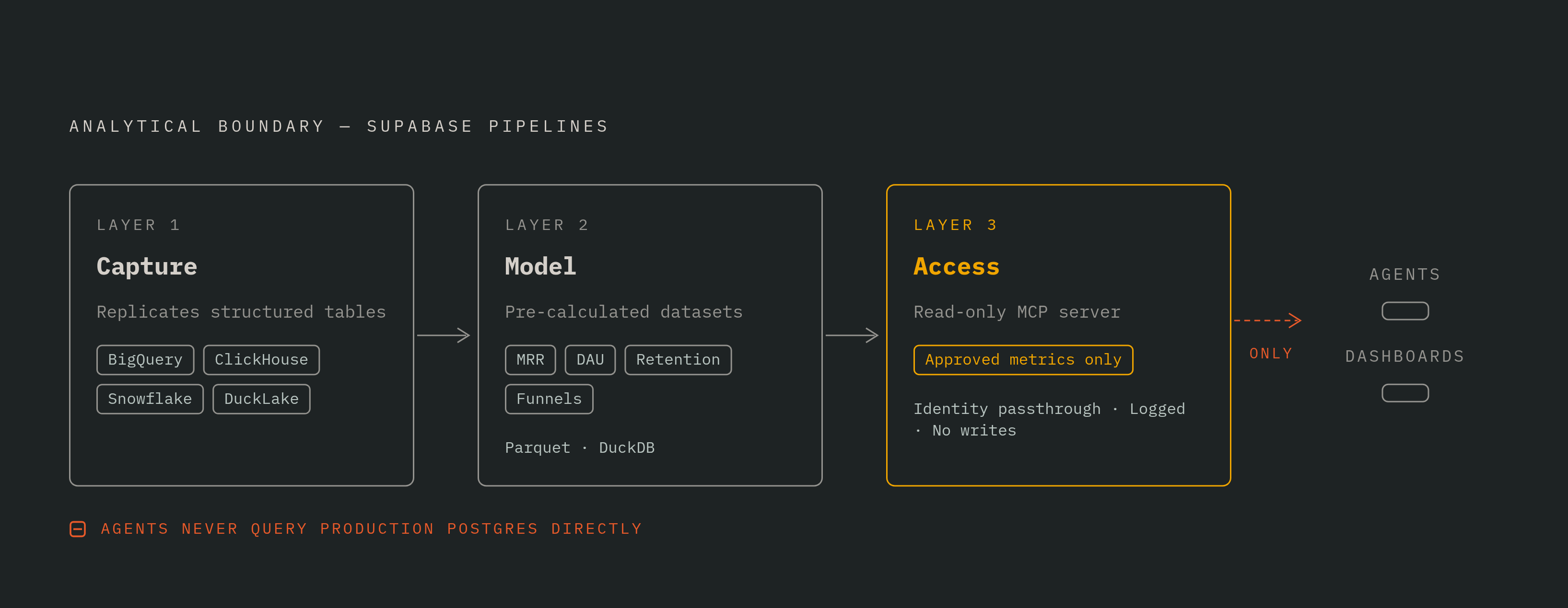
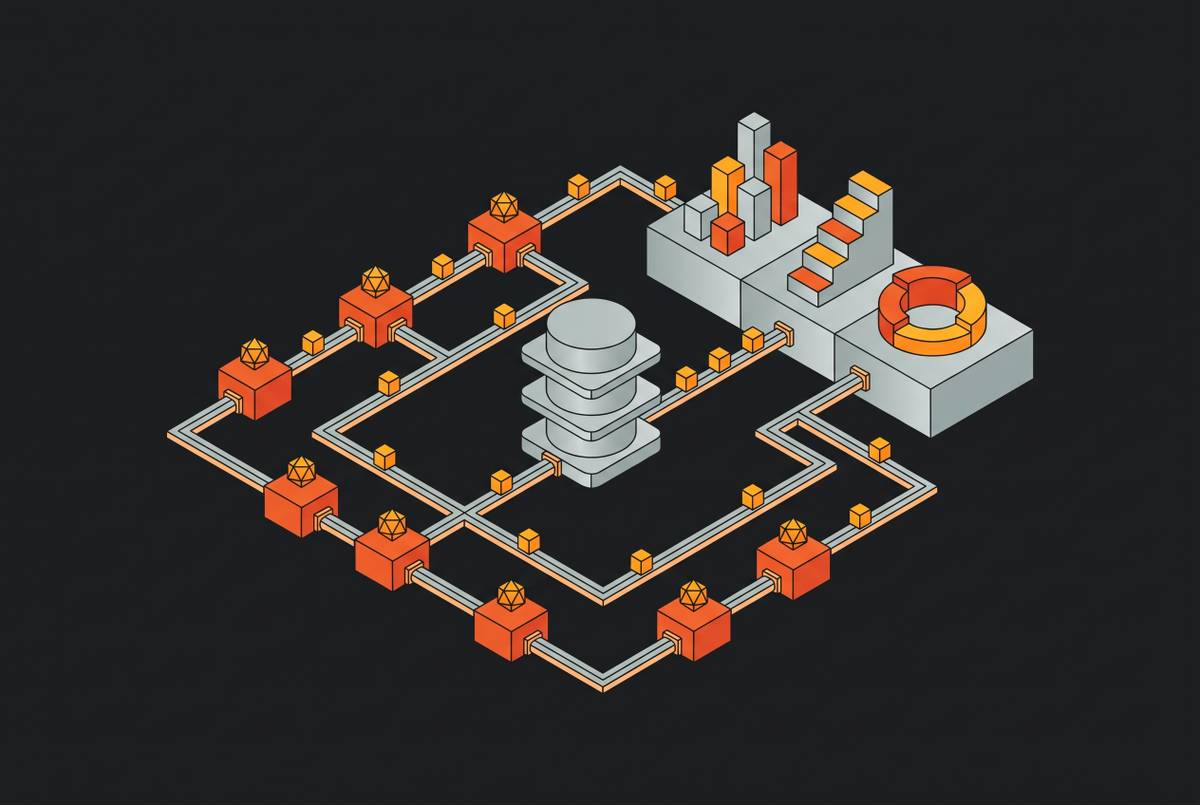
The architecture consists of three boxes, left to right. The first captures changes from Postgres through replication or a pipeline mechanism and sends them to a dedicated analytical store. The second transforms those records into governed, pre-calculated datasets. The third exposes those datasets through an access-controlled MCP server. Data moves through the boxes, but agents never send analytical queries back to the production primary.
Capture handles the movement of source records, while modeling fixes the definitions of metrics such as MRR, DAU, retention cohorts, and funnel steps. Access then determines which metrics, fields, and reports an agent may consume. These responsibilities should not collapse into one connector. Otherwise, a single agent request can become a replication task, a metric-definition exercise, and a permission decision at once.
The modeling layer can produce governed Parquet files or equivalent columnar structures queryable through DuckDB. The MCP server then presents approved data rather than database credentials, with read-only access and interaction logging. This boundary also limits dependence on an agent framework. A change from Claude to another model, or from one orchestrator to another, need not change the governed datasets underneath it.
How to build the instrumentation capture layer without stressing production
Structured table replication belongs on a replication or pipeline path. Supabase Pipelines entered Public Alpha in July 2026 with BigQuery as its sole available destination and limited beta support for automatic schema change replication. Destination availability subsequently expanded to ClickHouse, Snowflake, and DuckLake as full public alpha destinations. The early-access request form was retired on October 2, 2026.
Automatic schema change replication addresses a central weakness of custom capture scripts. It detects changes in source tables and applies them to analytical destinations, reducing the need to repair pipelines manually when source schemas change. Its support remains a selection criterion to verify. The architectural requirement is that analytical reads run against the destination, while production remains the source of operational changes.
The practical decision rule is to use Pipelines for structured table replication and log drains for operational or observability events. Read replicas, available on paid plans, provide a bridge for teams not yet ready for a full analytical destination. They remove analytical read traffic from the primary but do not define metrics or govern agent access. Postgres Changes still works for moderate-volume orders, messages, and notifications, but it is not suited to high-volume instrumentation.
How to model captured data into governed, pre-calculated datasets agents can actually use
An agent that calculates MRR from billing rows must decide how to handle timing, timezones, and trial inclusion, so its result may differ from that of another agent or team member. Modeling resolves those choices before the question arrives. A pre-calculated MRR dataset gives every authorized consumer the same defined number rather than asking each consumer to reconstruct its meaning.
Metric definition starts with a North Star metric that captures the product’s core value. For a subscription product, that might be weekly active users completing a key action, while a marketplace might use transactions per active user. Supporting metrics then map to Growth, Retention, Revenue, and Efficiency. Every metric needs a single defined source. ARR comes from billing, usage from the analytical warehouse, and cash from the bank, so disagreements can be traced to definitions.
Governed Parquet datasets queryable through DuckDB make those modeled results available without hitting a live database. FanOutQA illustrates the economic value of structure, finding reasoning over an ideal pre-structured store 28 times cheaper than agentic reasoning over unstructured data. For Supabase, that figure serves as an illustration. Modeling also sets a security boundary by leaving PII and raw payment data out of the datasets before they are published. Fields absent from an exposed dataset cannot be recovered by persuading an agent to change its query.
How MCP exposes governed datasets to agents without opening the database
MCP sets out how AI applications connect to tools and data sources outside them. Anthropic introduced it in November 2024 with three primitives, namely Tools for executable functions, Resources for contextual data, and Prompts for reusable interaction templates. Support from providers including Anthropic and OpenAI reduces the need for custom connectors per model. The protocol supplies a common access contract. The server’s configuration determines what that contract permits.
In this architecture, the MCP server exposes only governed datasets from the modeling layer. Read-only resource servers provide access without write capabilities, so agents cannot mutate the analytical results they consume. Identity passthrough brings the user’s permissions into each request. An agent acting for a sales analyst therefore receives only the access granted to that analyst. Read-only access is an enforced server boundary.
The same interface records who accessed which data and when. Its interaction log provides the basis for the immutable audit trail required by the compliance posture described for GDPR, HIPAA, and SOC 2. A compromised agent remains limited to exposed, pre-approved metrics. That limit reduces the harm an agent could cause, though MCP itself is only part of a security system. The protocol’s move to the Agentic AI Foundation under the Linux Foundation also keeps its governance independent of a single model provider.
Why agent reliability depends on the data layer, not the model
Agentic analytics projects fail when data access, governance, and accountability are inadequate, even when the underlying model is capable. DataSpace, the official evaluation benchmark for the KDD Cup 2026 Data Agents competition, reports that the setup that did best across six frontier multimodal models reached 66.34% accuracy. Changing the harness with the same backbone model produced a 15.36-point accuracy spread. Model choice alone cannot explain that gap.
Pre-calculated datasets remove repeated interpretation of raw business records, permissioned access constrains what an agent can retrieve, and interaction logs make access accountable. Consistency is part of this design. Research on agent systems built to keep transaction guarantees finds problems with consistency and isolation when agents work across live, non-transactional sources. A governed, pre-calculated result resembles a committed transaction in one important respect, because its value is defined before the agent reads it.
Accountability also extends beyond the final answer. Harvard’s TrajectoryDB research argues that agent trajectories, including tool calls, model invocations, and results, should be managed persistently as a distinct data type. Those records can be used for memory extraction, fine-tuning, cost monitoring, and security audit. An MCP interaction log provides a minimum viable record of the pipeline’s data-access activity, though not necessarily the complete execution trajectory.
Observability as a prerequisite for the pipeline to be trustworthy at scale
A defined metric can still produce a misleading answer if its underlying pipeline is stale. Supabase Postgres holds user data, auth tokens, Realtime channel metadata, and storage metadata, while also serving as the CDC engine for replication. Pipeline health therefore depends on production database health. p50/p95 latency dashboards, WAL lag monitoring, and connection counts provide the visibility needed to distinguish reasoning errors from delayed data. Without that distinction, an incorrect answer can send the team toward the wrong repair.
Supabase’s one-click Grafana Cloud integration, available as of July 2026 including on free plans, provides a pre-built dashboard with alerting and metrics. This lowers the setup burden for database monitoring. Log drains help teams see how their systems are running by sending logs to external systems for performance alerts. Supabase also supports agentic connections that monitor query performance at a regular cadence. That monitoring role is distinct from giving analytics agents unrestricted production access.
Access exposure needs its own operational review. Supabase tightened defaults in late April 2026, with the change becoming the default for new projects from May 30, 2026. New tables in the public schema of new projects are no longer automatically exposed through the data API, and access must be granted explicitly. Teams with older projects cannot count on those defaults to protect them. When teams set up pipelines on existing projects, they should check which tables are exposed.
How can early-stage Supabase teams get analytics and dashboards without a dedicated data team?
For an early-stage team, the choice is between defining metrics and access once or repeatedly reconciling ad-hoc queries, conflicting numbers, and agent requests that break under load. The latter work is easy to overlook. A connector’s ability to reach Supabase directly is therefore an incomplete criterion for an analytics or BI tool. More useful checks are whether workloads stay separate, metric definitions are shared, access follows permissions, and teams can see how well the pipeline is running.
A North Star metric and the four business buckets give a small team a common basis for weekly reviews. When sales, finance, and product use the same modeled sources, the discussion can focus on decisions. Delivery can also be proactive. Metrics pushed to an inbox, Slack, or mobile reach people without depending on someone remembering to open a dashboard. The same governed datasets can support both those updates and agent answers.
This operating model works for a three-person team as well as a thirty-person one because it centralizes work that otherwise repeats across people and tools. Capture follows a defined path, business logic lives in the modeled datasets, and agents share one controlled interface. Small teams still need to monitor that system. What they avoid is making every new question a fresh exercise in database access, business logic, and permission handling.
Sources
- Agentic Transaction: Towards ACID-Compliant Agent Systems
- DataSpace: Benchmarking Data Agents for Verifiable Analytics over Heterogeneous Workspaces
- Agentic Context Cracking: Token-Efficient Data Reasoning Agents via Adaptive Structuring of Unstructured Data
- TrajectoryDB: A New Database for Agent Trajectories