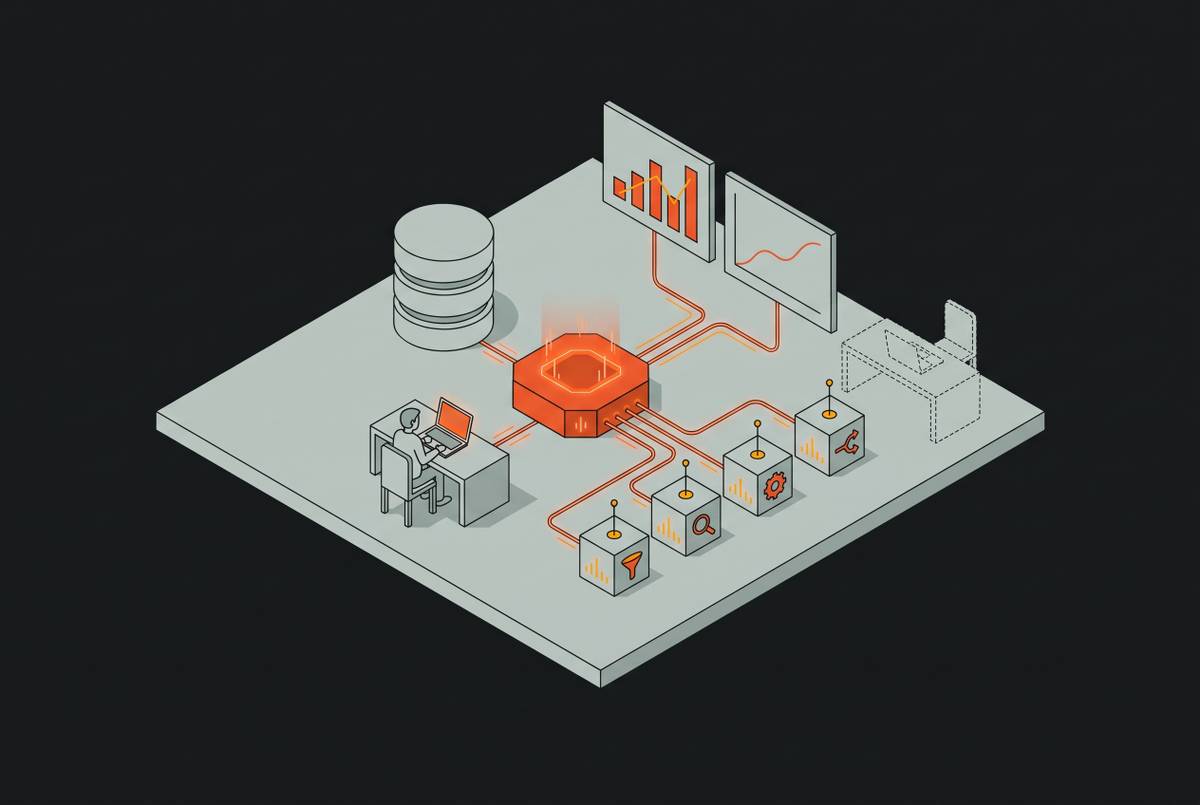
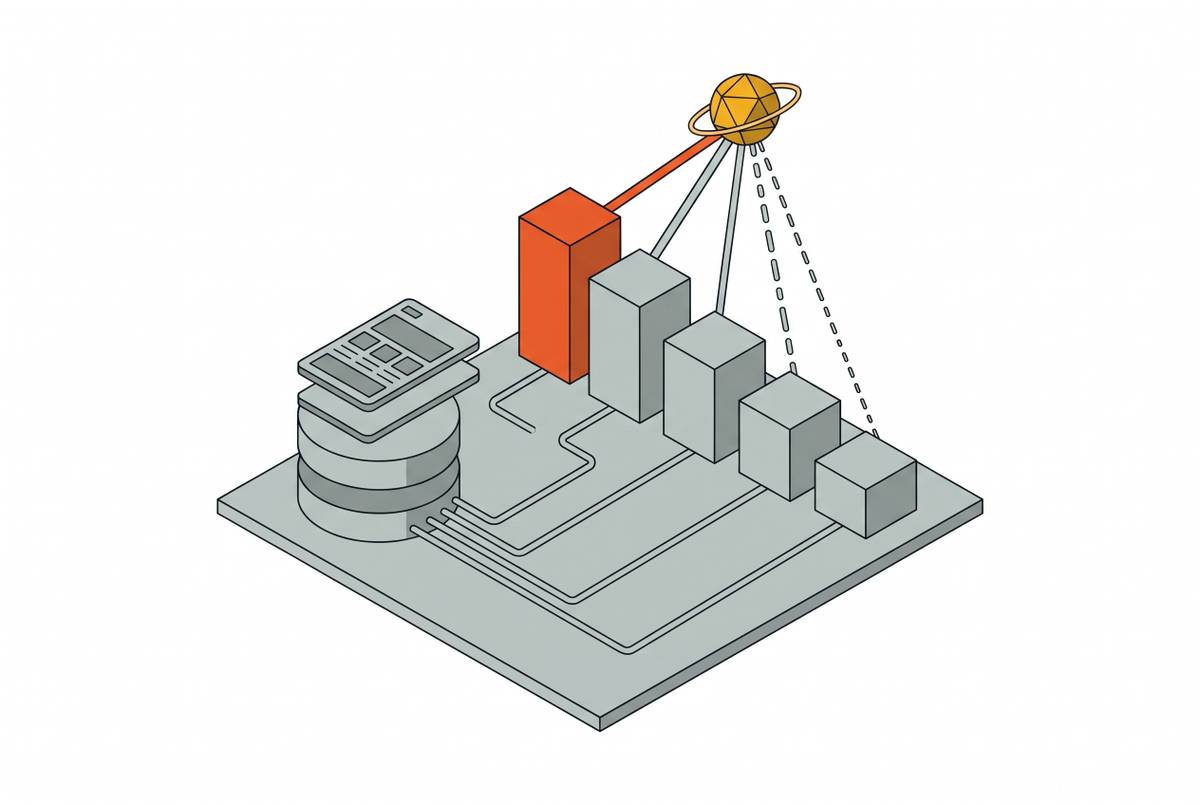
Designing a Visualization-Agnostic Analytics Contract Over Supabase When Your Consumers Are Agents Dashboards and APIs Simultaneously
Define metrics once so dashboards, APIs, and agents all report the same number.
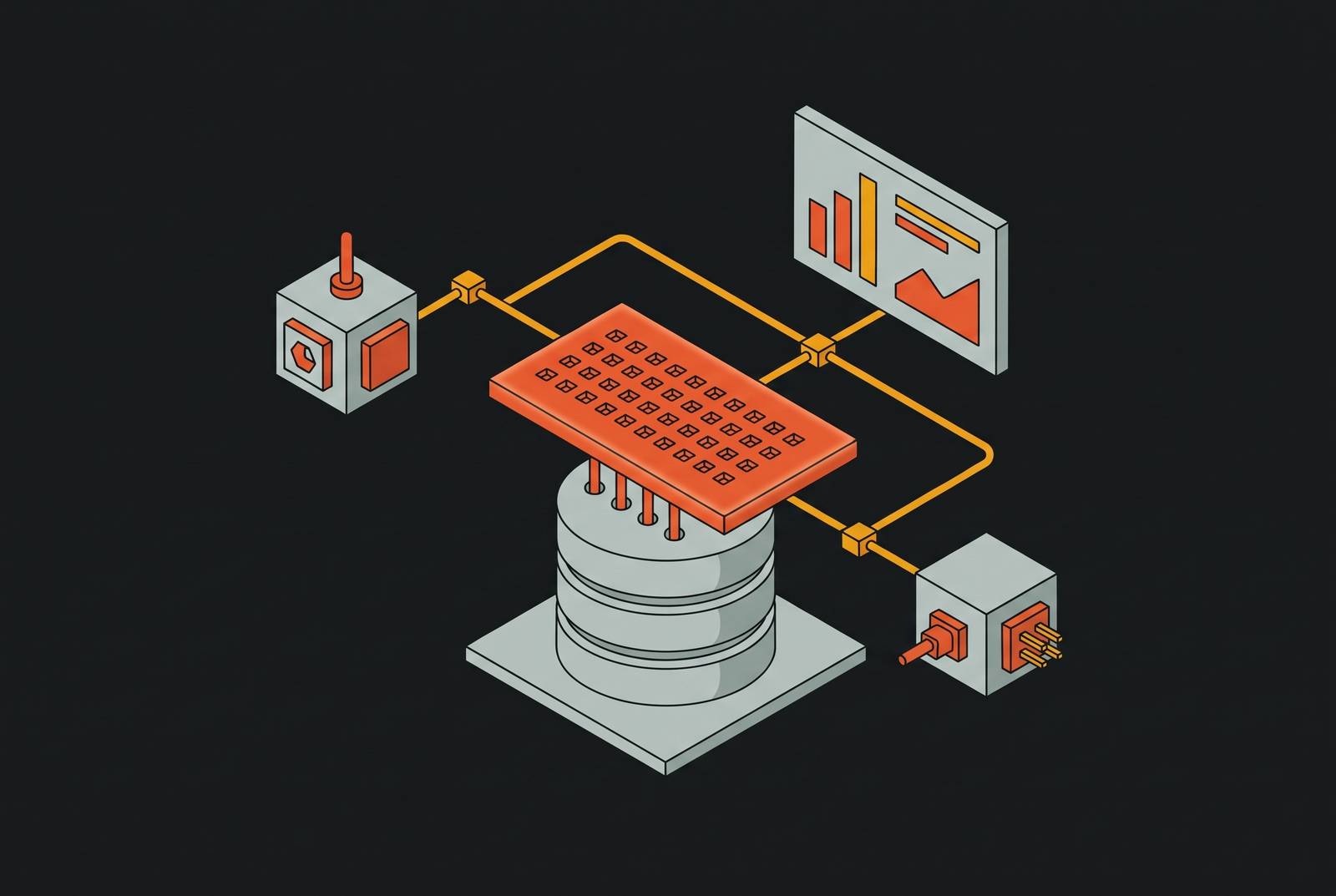
Analytics for Supabase teams needs a governed contract that separates metric definitions from delivery to agents, dashboards, and APIs. An architecture that lasts pre-calculates metrics into a read-only analytical copy, then gives each consumer its own interface so it can read results without running raw production queries. This makes visualization replaceable without letting the meaning of a number change.
Why three consumers hitting the same Postgres instance is an interface design problem, not a query problem
A team notices that its CEO dashboard, API endpoint, and agent report three different values for the same KPI. Each consumer reaches the same operational Postgres database, yet each calculates the answer differently. The queries may all run successfully. The failure is that nothing binds them to one definition, so fixing query speed cannot resolve the disagreement.
That disagreement exposes a collision between historically separate workloads. Human dashboards pull aggregates, REST or GraphQL APIs serve application reads, and autonomous agents run open-ended analytical queries at runtime. Their latency tolerance and trust levels differ. When all three reach operational tables directly, each interface becomes a place where business logic can diverge and analytical traffic can compete with application traffic.
Supabase makes that collision particularly concrete because it combines an auto-generated API, JWT-based authentication, and direct Postgres access. In the client-to-database path, there is no Express controller deciding which analytical interpretation or access pattern is acceptable. The missing boundary is an interface contract. Its job is to give every consumer a governed definition without making that consumer responsible for reconstructing the calculation from production rows.
What an analytics contract actually means — definition separated from delivery
An analytics contract is an interface specification that separates what a metric means from how a consumer receives it. The definition side owns the canonical calculation, while the delivery side presents its result in the required format. Neither side substitutes for the other. A dashboard can render a number, an API can serialize it as JSON, and an agent can receive it as a structured MCP Resource without choosing different business logic.
A strict data dictionary anchors that separation. Without it, one engineer can write SUM(revenue) while another writes SUM(amount_captured), so they get different Q2 revenue figures even though the data is valid. The ambiguity precedes the query. A governed definition resolves which calculation represents the metric before any consumer asks for it.
Visualization-agnostic therefore means more than supporting several charts. The contract has no dependency on a charting library, front end, or agent framework, so presentation can change without redefining the underlying number. This is the headless analytics pattern. Like a headless CMS separating content from presentation, it separates metric definitions from the dashboards, APIs, and agent tools that use them.
Why Supabase's design means the contract must be built before agents enter the picture
For a Supabase team, the architectural review starts with the authorization path. Client-side code reaches the auto-generated REST API using the user's JWT, with Row Level Security providing the authorization boundary in that path. The public anon key ships to browsers. Incorrect RLS policies can therefore expose data rather than merely produce an incorrect internal report, making policy design a prerequisite for analytical access.
RLS policies are evaluated on returned rows, and complex subqueries or joins without suitable indexes can turn analytical reads into sequential scans. The practical requirement is to index every column referenced in an RLS policy. Before analytics traffic arrives, observability should also cover disk space below a safe threshold, active connections above a danger percentage of the maximum, and p95 latency on critical queries exceeding a threshold.
Connection pooling is the next constraint to address. Serverless invocations and agent calls can each open connections, so the database can hit its connection limit as traffic grows. Tuning the connection pool can cut context-switch overhead by roughly 80%, but the database bottleneck remains when all that changes is the number of MCP server instances.
Agents that have direct production access also face the risk of RLS bypass. Place the MCP server over a governed analytical copy and keep agents away from the production instance entirely. RLS and pooling still need careful operation.
How MCP's three primitives map to the analytics contract's three responsibilities
The Model Context Protocol provides three primitives that map to execution, context, and repeatable workflow. Anthropic introduced MCP as an open standard for secure, two-way connections between data sources and AI tools. Its primitives provide a useful interface structure. The analytics contract sets the governed definitions and restrictions that this structure exposes, because adopting the protocol alone does not provide governance.
Tools let an agent ask to run a governed query against a pre-modeled dataset. Under this contract, a Tool does not give the agent freedom to invent SQL for an already defined metric. Resources supply the context that makes those calls intelligible. Schemas, dataset definitions, and metric dictionaries let the agent understand a number without inspecting production tables.
Prompts address the remaining responsibility by making analytical workflows reusable. A weekly revenue summary, churn cohort, or usage-by-plan-tier analysis can follow a codified template each time. The three primitives thus serve distinct purposes. A workflow organizes the work, a Resource explains its data, and a Tool performs the permitted operation.
In the headless pattern, a stateless MCP server exposes these capabilities to autonomous clients, while dashboards and REST APIs receive the same pre-calculated results through their own interfaces. The rendering paths need not be identical. Claude and a dashboard can answer the same business question from identical definitions because neither is responsible for inventing metric logic.
How do you get analytics and dashboards for your Supabase project with pre-modeled Parquet datasets queryable via DuckDB?
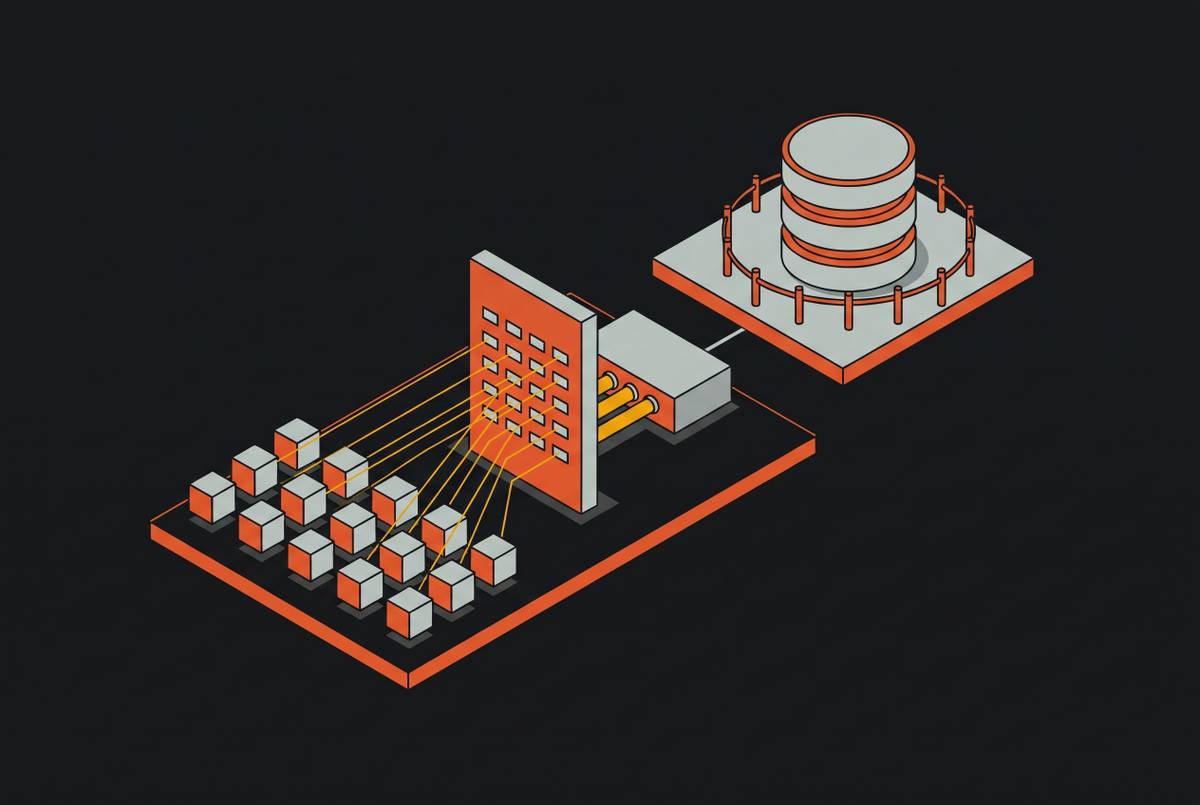
The governed layer consists of pre-modeled, pre-calculated datasets stored as Parquet and queried through DuckDB, so analytical consumers read prepared results. This is not a view on production. A live view would still direct analytical work to the operational instance, leaving the workload boundary unresolved.
DuckDB is a fast, column-oriented query engine over Parquet that does not need a separate database service. The analytical layer can sit beside the Supabase project without introducing a new data warehouse or changing the production schema. Pre-calculation is the decisive distinction here. The production system supplies the underlying data, and consumer queries operate on the governed copy for every answer.
A single MCP server provides structured agent access to those metrics, while dashboard and API endpoints expose the same datasets in their required formats. The analytical consumers have no production query path. Agent access is also read-only by design, because an agent bug, unexpected input, or prompt injection must not become a route to corrupting production data.
This is the data factory pattern, with one layer producing governed numbers for human teammates and AI agents. It also supplies useful criteria for evaluating BI tools that connect to Supabase. Direct connectivity alone is not enough. The relevant distinctions are whether the tool consumes canonical definitions, reads prepared results rather than live production queries, and leaves the presentation layer replaceable.
Designing the contract's security layer — pre-action authorization, not post-hoc auditing
A governed dataset limits what exists behind the interface, but it does not by itself authorize an agent's next action. Authorization must occur before the Tool executes. The OAP paper, Before the Tool Call: Deterministic Pre-Action Authorization for Autonomous AI Agents, characterizes this gap as a lack of authorization before an agent acts. Model alignment is probabilistic and post-hoc evaluation is retrospective, so neither provides deterministic policy enforcement at the moment of a tool call.
Authentication alone does not close that gap. CVE-2026-26118 showed how an SSRF vulnerability could let an authenticated attacker manipulate server-side requests and capture managed identity tokens. A valid credential was not a sufficient boundary. For an analytics contract, the architectural consequence is that the MCP entry point must enforce permission for the requested action before passing it to the governed dataset.
The Coalition for Secure AI's agentic IAM guidance treats agents as first-class identities that need their own capability-risk classification. Human RBAC logic alone is not enough because agents differ in their scope, when they act, and how they delegate. Credentials should follow Zero Standing Privilege principles. Short-lived, task-scoped access means an agent querying a revenue dataset does not also receive credentials that reach a user PII table.
The Redpanda Agentic Data Plane paper places security context and audit trails in infrastructure channels outside the agent's control. Here, infrastructure should collect structured transcripts of agent-data interactions without having to rely on the agent to report what it did. Those records require governed access as well. Pre-action checks and infrastructure-owned provenance are properties of the contract from deployment onward.
Because the agent reaches only the analytical copy, an authorization failure does not create a production path that the architecture never provided. The copy may still contain sensitive data. Isolation therefore limits the blast radius while policy enforcement governs access within that boundary.
Keeping all three consumers on the same number — the governed MCP layer as a scalable integration pattern
Once access is governed at a shared boundary, adding consumers need not multiply metric implementations. With point-to-point integration, each agent needs a separate connection to each source, which adds more connections when several model providers need the same sources. A shared MCP interface reduces that fan-out. Each new agent uses the governed access path without needing its own connector or its own way of interpreting the data.
MCP's governance has moved to the Agentic AI Foundation under the Linux Foundation, so the protocol has a vendor-neutral home. That separates the interface choice from a particular model provider or agent framework. Operational independence requires statelessness as well. Access-layer instances can then scale without tying a consumer to a particular server instance.
The 2026-07-28 MCP specification revision supports remote servers behind a plain round-robin load balancer, with routing through the Mcp-Method header. This removes the need for sticky sessions and shared session stores in that deployment pattern. It does not expand production database capacity. The analytical copy remains the boundary that allows access-layer scaling without multiplying direct agent connections to operational Postgres.
Federation with request pushdown complements this pattern for data not pre-calculated in the governed layer. Filters, projections, and aggregations execute at the relevant source, reducing the rows moved into the access layer. That serves a different purpose from canonical metrics. It must not become a second, competing calculation of an already governed number or a route for agents into production.
Pre-calculated results can be pushed into inboxes, Slack, and reports before anyone opens a dashboard because the calculation is already complete. The business payoff is shared confidence in the answer. When sales, finance, and an AI agent ask what ARR is, they receive one number from one calculation rather than competing versions that require an executive reconciliation.
What to build first — the minimum contract a Supabase team needs before deploying any agent
Before deploying an agent, a team needs the minimum boundary that prevents metric drift, production exposure, and unbounded agent access. Start with the data dictionary. Before writing queries, define five or fewer decision-driving metrics, with ARR, churn, active users, gross margin, and CAC payback forming the canonical early-stage B2B SaaS set. Give each metric one definition, one calculation, and one owner.
ARR comes from the billing system, usage from the analytics layer, and cash from the bank, so the CEO dashboard and the agent ultimately read the same pre-modeled number. Next comes readiness of the Supabase project. Put the connection, disk-space, and p95 latency alerts in place. Index RLS-referenced columns before building the governed layer over the underlying data.
The next step is the controlled agent path. Route every agent request through the MCP server to the governed copy, with read-only datasets, short-lived task-scoped credentials, and structured transcripts collected by infrastructure. Then connect the human and application interfaces. Dashboards and APIs should receive those same pre-modeled datasets rather than recreating their calculations in separate query code.
From there, expansion belongs in the definition layer. New metrics, agents, and dashboards can extend the contract without making existing consumers responsible for how a number is produced. The delivery interface remains stable as coverage grows. That is the minimum foundation for analytics that serves Supabase applications and autonomous agents without sacrificing a shared meaning for the numbers.
Sources
- State of AI Agent Security Report 2026
- Before the Tool Call: Deterministic Pre-Action Authorization for Autonomous AI Agents
- Agentic Identity and Access Management
- The Importance of Out-of-Band Metadata for Safe Autonomous Agents: The Redpanda Agentic Data Plane
- Architecture overview - Model Context Protocol