Headless Analytics API Contracts That Protect Supabase Transactional Performance at Agent Query Scale
Protect production data from agent queries by defining metric contracts before queries run.
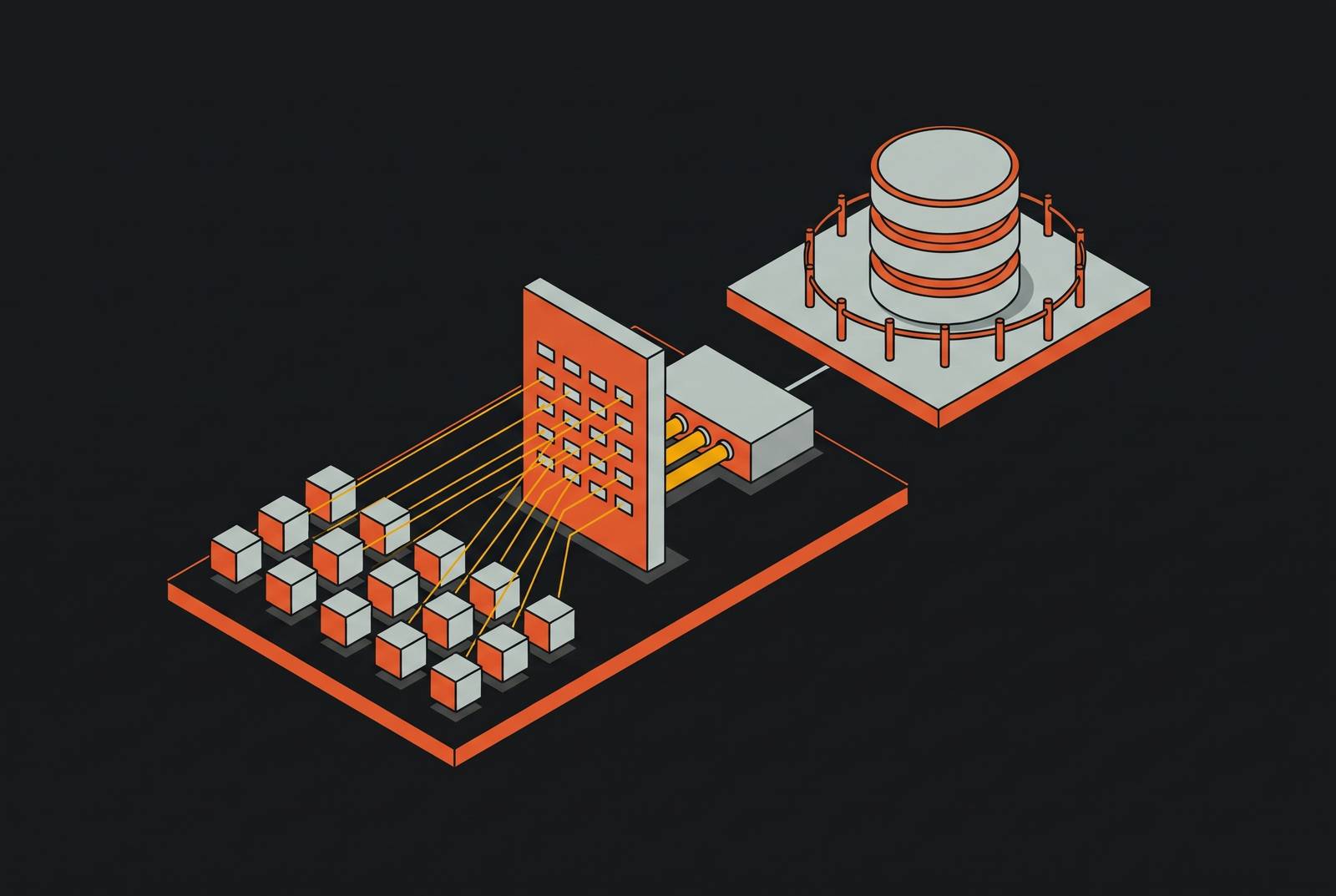
Analytics for Supabase teams should put dashboards and agents behind a shared metric contract and route analytical queries to a governed copy of production data. A direct database connection is not a sufficient safety boundary. Headless analytics protects transactional performance only when the API defines what callers may request, whose data they may receive, and where queries may run before any query is built.
Why analytics APIs at agent scale are fundamentally different from analytics APIs at human scale
Human analysts query on a schedule, with intent they can articulate, while agents query continuously, opportunistically, and in parallel. An API designed to answer deliberate requests becomes a safety boundary when callers can generate new requests without a human pause between them. What the interface allows must therefore account for volume, autonomy, and query chains that are hard to predict.
A single analytics snapshot can return approximately 55 tokens of structured JSON, a fraction of the token cost of a dashboard screenshot. An agent can combine analytics, git history, and payment data in a single turn, making the resulting query volume difficult to predict from one endpoint alone.
MCP standardizes access and delivery, but it does not establish what a metric means or who may receive it. The enforcement gap remains. Endpoint documentation describes what a service returns, whereas an agent-facing contract must constrain what it is allowed to return, to whom, and at what rate.
What Supabase Postgres actually hits first when agents query it directly
A Supabase agent system will generally encounter a Postgres connection limit or Realtime channel quota before an LLM rate limit. The database is the bottleneck to plan for. Serverless Edge Functions open a new database connection per invocation by default, so a traffic spike without pooling can consume max_connections in seconds. Pointing those functions at the direct connection string is a common trigger.
Supavisor absorbs that connection pressure, but pooling does not turn transactional Postgres into an isolated analytical service. On smaller compute tiers, RAM and disk I/O exhaustion can appear first as slower queries and pool pressure before an explicit failure. Analytical traffic then competes with the transactions the application depends on. This is an architectural workload conflict.
A read-only role does not itself restrict which rows an agent can retrieve, and misconfigured access can bypass row-level security. A confused agent can therefore pull thousands of records with sensitive fields through a query that looks legitimate.
Why session-level leakage makes query-time enforcement insufficient
An agent can issue permitted queries, store intermediate results, and synthesize an answer that reveals information the policy was intended to protect. Leakage is a property of the accumulated results. Evaluating each request alone cannot establish what the caller can infer from the whole sequence.
Read-only roles and row-level security help control each query, but they cannot control how the agent reasons across results. Multi-tenant access introduces another distinction. Tenant identity must come from a server-verified session or signed token. A prompt is not an authorization system.
Consequently, the permitted exposure must be defined upstream of query construction. The contract needs to govern what information the API can release, rather than letting each caller negotiate access with the database at execution time. It establishes the policy boundary within which session-level exposure must also be governed.
The six-part contract an analytics API must define before a query is built
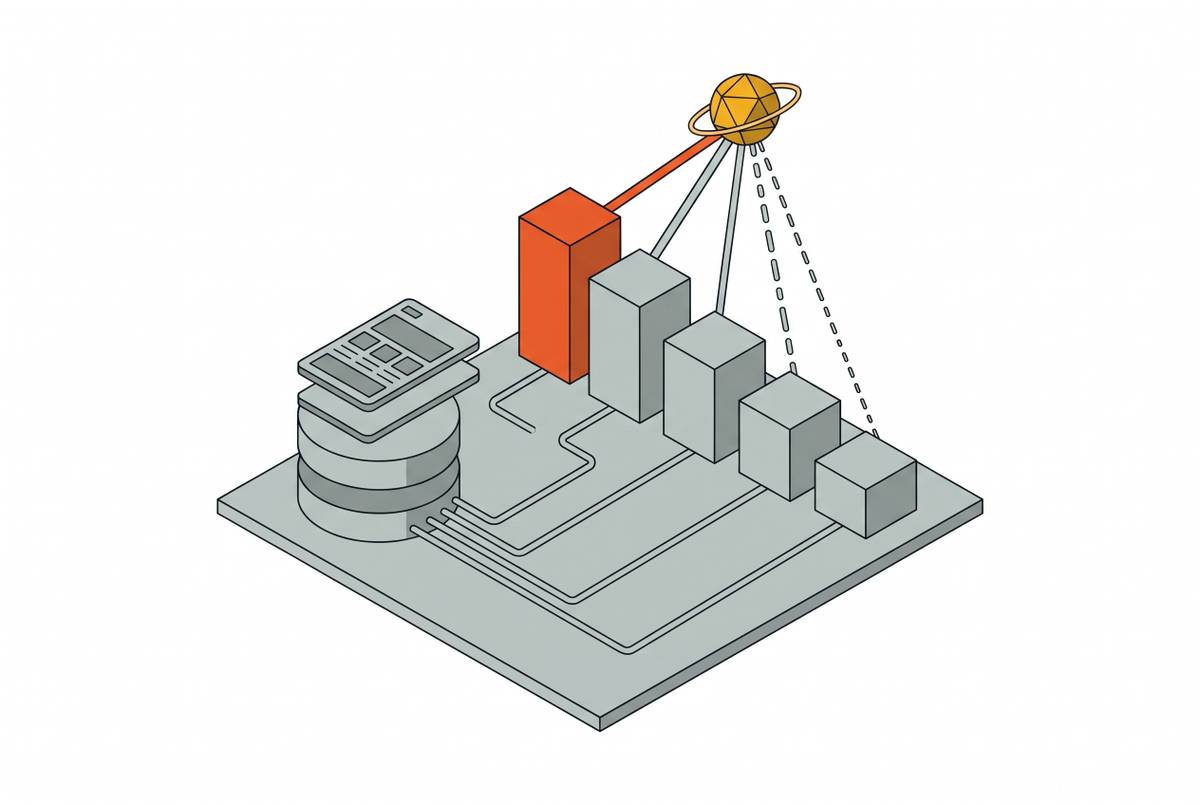
A governed API separates six decisions that a natural-language-to-SQL call must not collapse. Metric definition establishes calculation, grain, and time logic through human-reviewed, version-controlled rules. A name alone is insufficient. If one engineer uses SUM(revenue) and another uses SUM(amount_captured), the same quarter can yield different answers that an agent silently reproduces.
Tenant policy establishes whose data the caller may receive, using identity verified outside the model. It must remain independent of the requested metric. Otherwise, a valid business question can still lead to a cross-tenant request that is not allowed. Schema context then limits the agent’s view to relevant tables, columns, annotations, and trusted query examples.
The tool registry defines typed actions and validated arguments, accepting metric names, filters, and dimensions. The execution boundary fixes the database instance and credentials under which the resulting query may run, excluding production Postgres as an analytical target. Audit and provenance complete the contract through generated SQL, parameters, definition versions, and result metadata returned with each response.
Why compile-time enforcement is categorically different from runtime enforcement
Compile-time enforcement makes an unauthorized query plan unavailable to the caller. In the runtime-enforced pattern, the system has already built a plan and spent resources before rejecting the request. At agent scale, repeated refusals can consume the connection budget without producing useful results.
A compiler governed by the contract cannot return a plan outside the caller’s permitted scope. A plan that is not allowed never opens a database connection. This places authorization in the construction of the request rather than relying solely on an execution-time check. Database permissions still serve a purpose, but they are not asked to compensate for an unconstrained query generator.
For self-hosted deployments, this difference also shapes the choice to build or buy. An open-source core may come without the agent API, and many tools offer the serving layer or MCP server only as a paid product. The relevant evaluation is therefore whether the deployed access layer implements the contract before execution.
How do you get analytics and dashboards for your Supabase project without querying production?
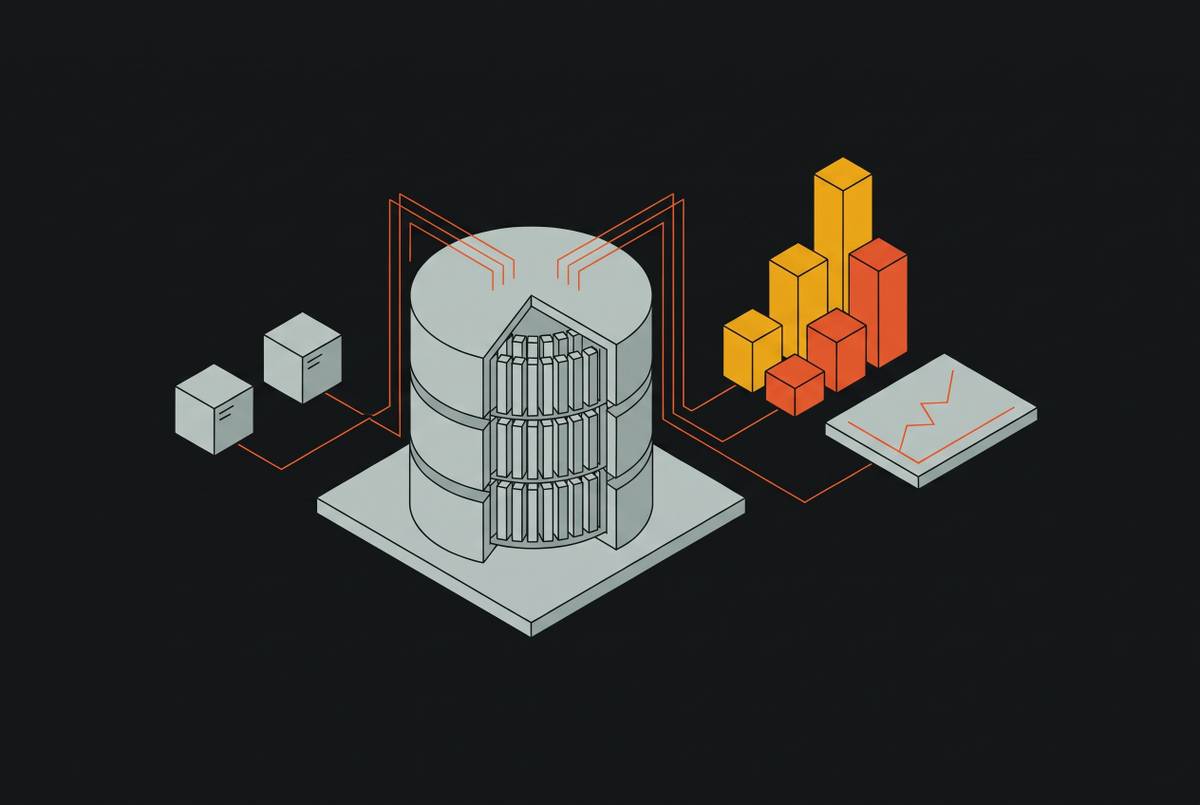
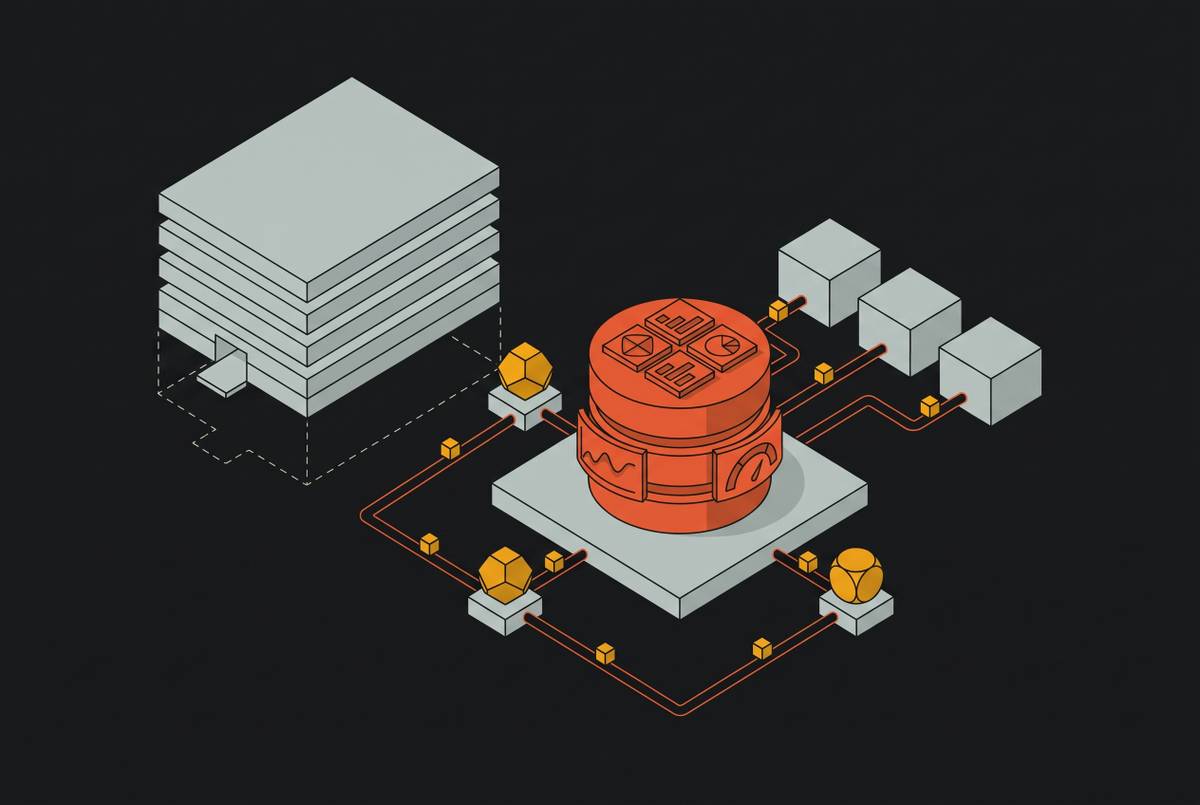
The execution pattern is a governed analytical copy, with transactional traffic remaining on Postgres behind Supavisor. Agents use an isolated read path instead. The contract selects that path before a query is attempted, so analytical requests never enter the production connection pool. Dashboards and agents can share metric definitions without sharing production execution resources.
Supabase Pipelines streams Postgres data to ClickHouse, BigQuery, DuckLake, and Snowflake in near real time. These targets provide places to execute analytical queries away from the production instance. The selection criterion is not merely whether a tool connects directly to Supabase, but whether its execution path preserves this separation.
Supabase acquired Hydra, the maintainers and co-developers of pg_duckdb, to build Supabase Warehouse. The self-hosted option accelerates analytical queries without exporting data or managing a separate system, but acceleration alone is not workload isolation. Multigres adds built-in pooling and multi-node high availability, promoting a replica in seconds with committed writes intact after a node failure. Those features help the system recover from failures, while the contract still sets where requests go during recovery. An MCP server that sends analytical requests back to production has crossed the boundary, regardless of how convenient that route appears.
What stateless MCP changes about scaling the access layer — and what it does not change
The 2026-07-28 MCP specification removed protocol-level sessions, so any server instance behind a plain round-robin load balancer can handle any request. Session affinity is no longer required. Data teams can therefore add MCP server instances without maintaining sticky sessions, simplifying horizontal scaling of the access tier.
That improvement does not enlarge the database connection budget. If every instance sends analytical queries to production Postgres, the same downstream bottleneck remains. Nor does protocol statelessness erase an agent’s accumulated knowledge. Cumulative disclosure tracking must live in the governed data layer.
The 2026 MCP roadmap separates enterprise concerns, including audit trails, SSO authentication, and gateway patterns, from the Tasks primitive for asynchronous agent calls. Supabase MCP Server provides a concrete bounded-access example through query_logs, which runs read-only SQL over a bounded window of logs per request. Such limits come from the tool’s governed read path.
Observability as the mechanism that proves the contract is holding
A boundary that cannot be measured cannot be defended. For Supabase teams, verification spans query behavior, connection activity, and system resources. Query-level signals reveal which statements are slow and how often they run, while connection-level signals reveal usage and waiting. CPU, memory, I/O, disk, and replication lag show whether the workload is straining the underlying system.
pg_stat_statements, enabled by default on most managed Postgres, records query mean time, total time, and call count. It provides a foundation for detecting analytical queries that reach production despite the routing contract. Supabase’s Metrics API exposes metrics compatible with monitoring systems covering CPU, I/O, WAL, connections, and query statistics. Active connections getting close to max_connections and a hot-data cache hit ratio below its accepted baseline are signs of trouble.
Elastic’s Supabase integration, announced September 2026, adds visibility into database size, transaction commits and rollbacks, WAL volume, replication lag, bgwriter activity, and statement statistics. These signals connect an API-level promise to database-level behavior.
What metric consistency across humans and agents actually requires at the definition layer
Workload isolation cannot correct an inconsistent definition of revenue. If an analyst and an agent use different calculations against the same underlying data, both may respect the execution boundary while producing incompatible answers. The agent has no basis for flagging that disagreement unless a reference definition exists.
Metric sprawl begins when each consumer defines business terms locally, and agents amplify this existing problem. The remedy is a versioned metric contract containing calculation, grain, time logic, and known assumptions. A human must be able to inspect it. A test must also be able to show that the compiled query matches the definition, connecting business intent to executable logic.
Headful and headless products can then share metric semantics while executing in different places. The common layer is the definition. This does not require every team to begin with a warehouse-scale semantic modeling product. Glossary entries, table and column annotations, and trusted SQL for the most important questions can form a reviewable, testable starting contract that both humans and agents use.
Defining the contract before the agent exists — the architectural commitment that makes the boundary real
Teams should define metric contracts and tenant policy, build the route to a governed analytical copy, instrument the boundary, and then connect agents. Reversing that order makes enforcement a repair effort. By the time performance degradation or inconsistent answers expose the gap, production queries have consumed resources and definition drift has entered agent outputs.
Salesforce Headless 360, announced April 2026, frames the trust layer as shared infrastructure for humans and agents. Mixpanel Headless, launched May 2026, illustrates the corresponding reproducibility requirement through a typed code surface that returns the same shape for the same inputs regardless of caller.
For Supabase teams, the practical starting point is pre-modeled metrics, governed access, and verification that analytical traffic stays off production. A full semantic layer deployment can come later. The decision is not whether an agent-facing analytics API will have a contract, but when that contract becomes explicit. Teams that define it before agents arrive control the boundary, while teams that define it afterward are chasing it.