Defining a Metric Contract for Cross-Functional Teams
Establish shared definitions so cross-functional teams stop debating the same number.

A metric contract defines how cross-functional teams compute, own, and change a shared number. Its purpose goes beyond documenting a calculation. It is the operating agreement that lets Finance, Marketing, Sales, Engineering, and their AI agents use the same definition every time, with a governed process for resolving disputes and revising the terms.
Why cross-functional teams keep arguing about the same number
Two department heads present different revenue figures in the same meeting. Both have reports to back them up, and both think their number is right. The discussion shifts from how the business is doing to which report people can trust. Yet both calculations may be free of arithmetic errors. The disagreement started earlier, when the teams made different choices about what to include in the number.
Finance and Customer Success can use “churn” to describe different measures, while “pipeline” can mean one thing in the CRM and another in the forecast model. Each function has its own language that fits its work. As filters, calculations, and reporting windows change independently, that language gradually diverges without anyone explicitly deciding to break agreement.
Separate systems make the divergence harder to detect. When each function sees only its own reports and extracts, a locally consistent number can remain incompatible with the number another team uses. AI agents add pressure to this weakness because access to the same raw data does not give them a shared rule for calculating a result.
What a metric contract actually is, and what it is not
A metric contract is an operating agreement that specifies exactly how a number is computed, who owns it, where its authoritative definition lives, and which changes require formal revision. It joins business meaning to a calculation and an accountable decision process. A dashboard displays the result of that process. The contract establishes the terms under which the result can be called the agreed metric.
A data dictionary names and describes fields or metrics, but a contract adds ownership, change control, and enforcement. A warehouse schema describes data structure rather than the full agreement about business meaning. A BI tool’s metric layer can run a calculation, and a general governance policy can set broad rules, but each leaves out parts of the operating agreement for a given number.
Grain shows why the distinction is consequential. Average Order Value is a ratio of two sums computed at the order grain and then aggregated as a ratio. Taking the average of pre-aggregated rows gives a different, wrong result. Both calculations might appear under the same dashboard label unless the contract specifies the required grain and aggregation. A shared interface cannot repair that omission because the organization has yet to agree on what to measure.
The six elements every metric contract must specify
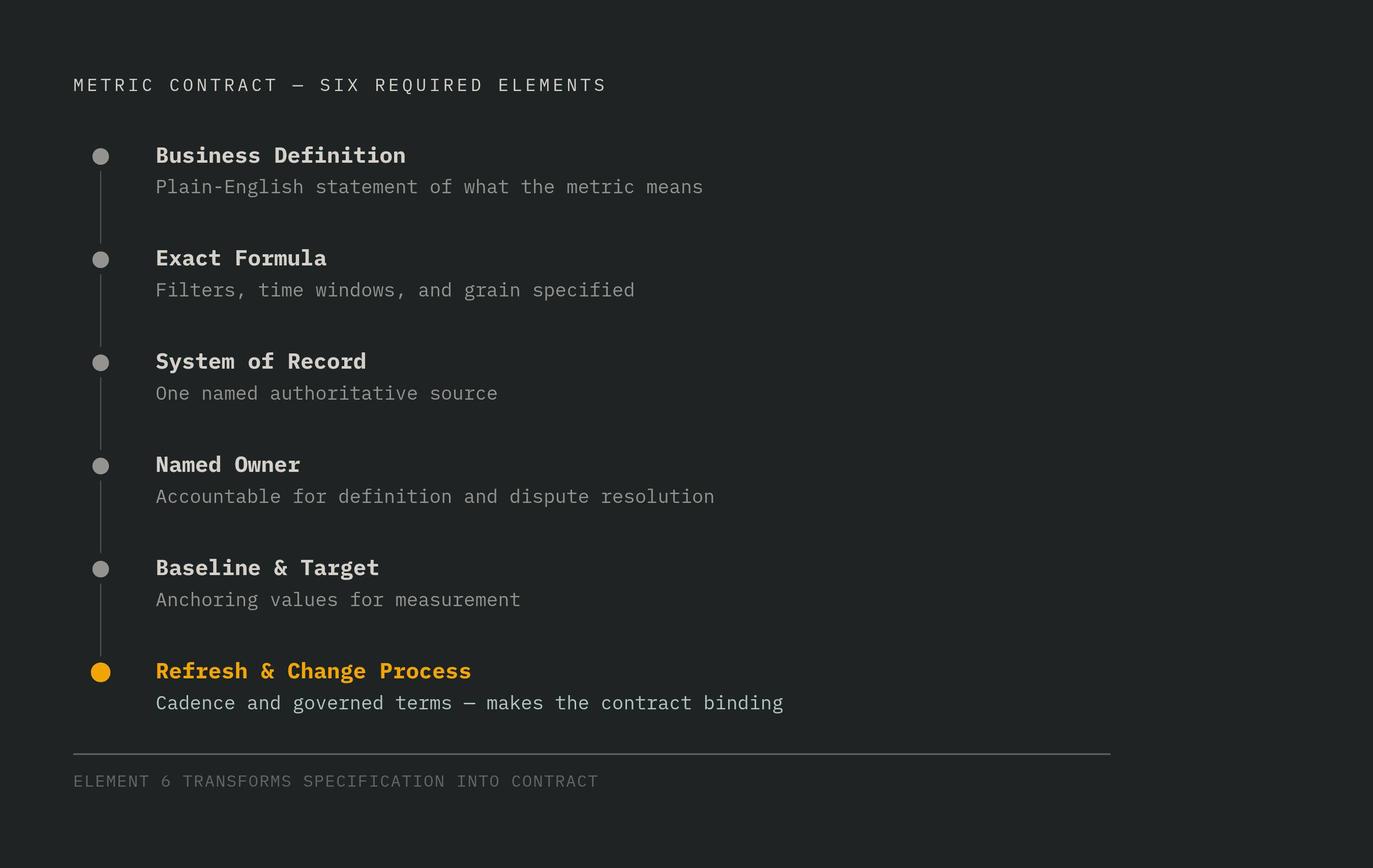
First, the contract needs a plain-English definition of the metric’s business meaning. The wording must make clear how the measure differs from similar concepts, beyond what its name says. A new hire and an AI agent need an unambiguous referent. Without it, a technically precise calculation can still answer the wrong business question.
Second, it needs the exact formula, including filters, time windows, and grain. Grain specifies what one input row represents, what one output row represents, and which aggregation connects them. A verbal description of the calculation is insufficient. When these choices stay open, downstream consumers are free to get different answers from the same inputs.
Third, it needs a system of record. This is one named authoritative source, selected from the CRM or ERP, with the table or endpoint specified where possible. The source must not depend on who asks. Otherwise, agreement about the formula can conceal disagreement about the records to which it applies.
Fourth, it needs one named owner accountable for the definition, approval of changes, and disputes. Responsibility cannot stop at a department name. Shared participation is necessary for cross-functional agreement, but shared ownership without a named individual leaves no clear person responsible when that agreement is challenged.
Fifth, it needs a baseline and a target, which establish the current measured value and the goal. A number alone does not establish progress. Teams need a baseline to tell whether what looks like improvement is noise, and the target says what outcome the shared measure should help them reach.
Sixth, it needs a refresh cadence and a process for making changes. These specify how often the number is recomputed, when a value becomes official, and how a proposed revision reaches approval. Silent edits violate the agreement, even when technically sound. This element turns a specification into a contract by governing how its terms can change.
Why ownership and review cadence are where contracts break down in practice
A complete specification can still fail when its owner lacks authority to defend it. A team whose local metric looks favorable has a real incentive to resist a definition that weakens that result. Governance must give people a way to challenge the number without treating the challenge as an attack on the team that produced it.
A Metrics Council gives teams a place to make those decisions. It owns definitions, manages access, and handles exceptions on a monthly cadence. The named metric owner is still responsible for that metric’s definition. The council handles the cross-functional tradeoffs that one owner may not be able to settle alone, especially when separate dashboards and extracts have already begun to diverge.
Review also needs to match the metric’s velocity. Weekly reviews look at leading indicators and blockers, monthly reviews look at variance and problems with definitions, and quarterly reviews check whether the measure still fits company goals. When a metric turns red, the useful question is what is blocking it. A proposed formula, filter, or time-window revision then needs a proposal, review period, version bump, and communication to downstream consumers. Without that process, an edit in a BI tool can quietly override the agreement.
How metric seams between functions create false wins and real losses
The cost is clearest when one team’s output is another team’s input. In a lead-to-close value stream, Marketing may count a lead as qualified using rules that Sales does not accept. The handoff fails even though the originating team’s dashboard can show success.
The qualify-to-convert seam exposes the same mismatch from the next stage. One team measures the volume it has qualified, while the next measures whether those leads convert. If the qualification definition is not shared, growth in the first measure does not establish improvement in the second. Demand can be lost between the functions before that loss is visible in a lagging indicator.
This is how local wins become joint failure. Each function can hit its own target while the company misses the shared outcome, because departmental reporting does not necessarily measure the handoff itself. A contract therefore needs to govern the intersection as well as each team’s primary KPI. Both teams need a number they agree on that shows whether work has passed successfully between them. The practical test is whether they can identify who owns its definition, where the source of truth lives, and who resolves a dispute.
What changes when AI agents become consumers of the same metrics
For a human reader, an ambiguous metric can trigger a conversation. An agent can instead choose an interpretation and return a confident calculation without surfacing the choice. In the CFO scenario, three agents get three revenue figures from raw tables. One finance agent returns $41.2 million by summing completed orders and subtracting refunds. The discrepancy comes from independently derived expressions, grains, and filters.
Autonomous use magnifies the cost of that ambiguity. A calculation that no human explicitly approved can become an input to further work, so definitional errors can compound beyond a disputed report. Human-legible prose is no longer sufficient. The contract must encode the expression, grain, allowed dimensions, filter, time semantics, and additivity in a machine-readable form that leaves those choices settled.
The access architecture must enforce those terms. Agents should not have production database credentials, and analytical queries should pass through a governed layer that applies definitions and logs access. Row-level security and column-level masking must constrain results at query time. A fraud detection agent may see transaction amounts and timestamps but not payment card numbers because the governance layer restricts access. Even that architecture needs a canonical metric definition to be complete, since controlling access alone cannot settle how to calculate the number.
How the Model Context Protocol turns a metric contract into a governed data interface for agents
The Model Context Protocol gives AI applications a standardized open interface to connect to external systems. It includes data and transport layers, but it does not supply the business meaning of revenue or churn. Access is not a definition of the metric. The contract belongs in the semantic layer exposed through MCP, where the agreed calculation can govern what an agent requests and receives.
The headless analytics pattern makes that separation concrete. A governed backend serves human interfaces and agents from identical definitions rather than allowing each consumer to reconstruct the metric. A finance agent and a sales agent can connect to the same MCP server and see the same net_revenue_usd tool with the same schema. That tool derives from the shared contract. Generating the interface from contracts allows different agent frameworks to consume one definition without maintaining agent-specific formulas.
MCP’s uniform interface does not remove the need to enforce access controls and masking in the semantic layer. For Supabase teams, this means keeping agents away from the production Postgres instance and querying a governed analytical copy through the server. That separation keeps agent traffic away from the production connection pool and its row-level security policies. The protocol exposes the interface, while the backend enforces the agreement and access restrictions.
How to put a metric contract in place before definitional drift takes hold
A team putting contracts in place should first map the three to five most important value streams, including “Lead to Close,” “Acquire to Onboard,” and “Issue to Resolution.” Each stream should receive one shared outcome metric before departmental KPIs are addressed. This makes the first agreement answer a cross-functional question. It also establishes the habit of defining success where responsibility passes between teams.
Next, the participating functions should complete the specification in dependency order. Business meaning comes first, followed by the formula and explicit grain, system of record, named owner, baseline, target, refresh cadence, and change process. The difficult grain discussion cannot be deferred. Teams need to settle what one input row represents before agreeing on how those rows will be aggregated.
Governance should follow with a Metrics Council and a per-metric executive owner. The council settles disputes over definitions, while the executive owner reads the signal and suggests what to do to correct course when the metric moves. The review rhythm belongs in the agreement itself.
The contract should be encoded in a semantic layer serving dashboards, scheduled reports, and agents. For Supabase and Postgres teams, pre-modeled governed datasets outside production support that separation. Finally, revisions to formula, grain, filter, or time window become official through a version bump and notice to human and agent consumers before taking effect.