How Agentic Workflows Corrupt Metric Consistency When Supabase Lacks a Definition Authority Layer
Agents on Supabase corrupt metrics when nobody owns their definitions.
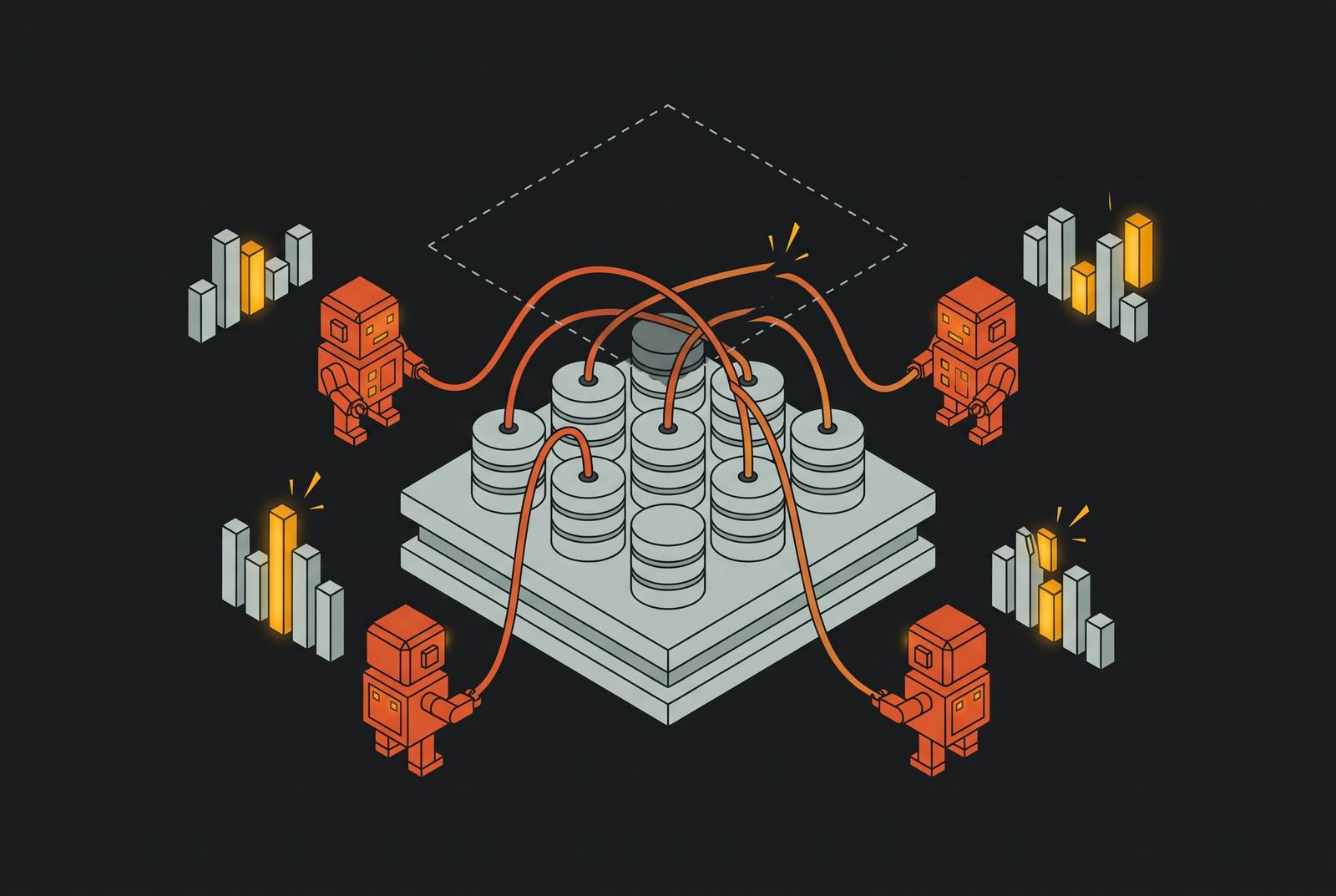
Agentic workflows on Supabase can corrupt metric consistency without producing a single query error. The cause is not missing data, but missing authority over what the data means. When agents reconstruct metric definitions from production tables, plausible calculations become competing versions of truth. A governed definition layer stops that divergence by fixing calculation logic before agents consume or pass on a number.
Why Supabase teams face a metric definition problem that worsens as agents are added
Supabase teams start with shared production Postgres, broad service-role credentials, and no metrics layer. In this Supabase setup, agents, human analysts, and application logic use the same underlying tables. Those tables hold records but have no canonical business definitions. Access alone cannot distinguish a certified metric from an abandoned query or a provisional calculation someone wrote last quarter. An agent can therefore reach the data needed to answer a question without having any authority to determine which answer is valid.
Human analysts have traditionally filled that gap through conversation and convention, resolving disagreements about what a metric includes before treating it as settled. Agents construct SQL from the context supplied to them and treat the result as authoritative. For early Supabase teams without people whose job is to handle data, whoever wrote the last migration often ends up in charge of definitions. Adding agents means more use of the data without deciding who owns its meaning.
How agents query without definition authority and why the failure is structurally silent
An undefined metric does not necessarily produce invalid SQL. An agent can choose tables it can access, apply filters that look right, and return a number even when nobody has approved that calculation. The query succeeds on the database’s terms. Its success says nothing about whether the result matches the business definition the reader had in mind. Without a definition authority layer, neither the agent nor the person reviewing its output has a reliable basis for distinguishing a certified calculation from an improvised one.
That improvisation can change between runs because session context, prompt wording, and the available schema influence the SQL generated. “MRR” on Monday may therefore use different logic from “MRR” on Wednesday. Consider upgrades within an MRR calculation. Sales may count them as new MRR, while Finance counts only net new. An agent without a governing definition may adopt either interpretation or land between them, depending on which tables it samples and which columns are most salient in its context window.
The failure remains silent because a plausible interpretation needs no exception to complete. A confident answer can conceal an unresolved choice. Divergence becomes visible only when someone compares outputs and notices that the same metric name refers to different calculations. By then, a downstream forecasting agent may already have consumed the result as a valid input. It produces a forecast from that premise.
Why multi-agent orchestration multiplies divergence rather than averaging it out
Adding agents does not give the team a way to agree on what a metric means. Each specialist introduces another opportunity to reconstruct the definition, while each handoff allows that interpretation to spread. A downstream agent that accepts an upstream number has no reason to revisit how upgrades, exclusions, or calculation grain were handled unless it has a governing definition against which to assess them.
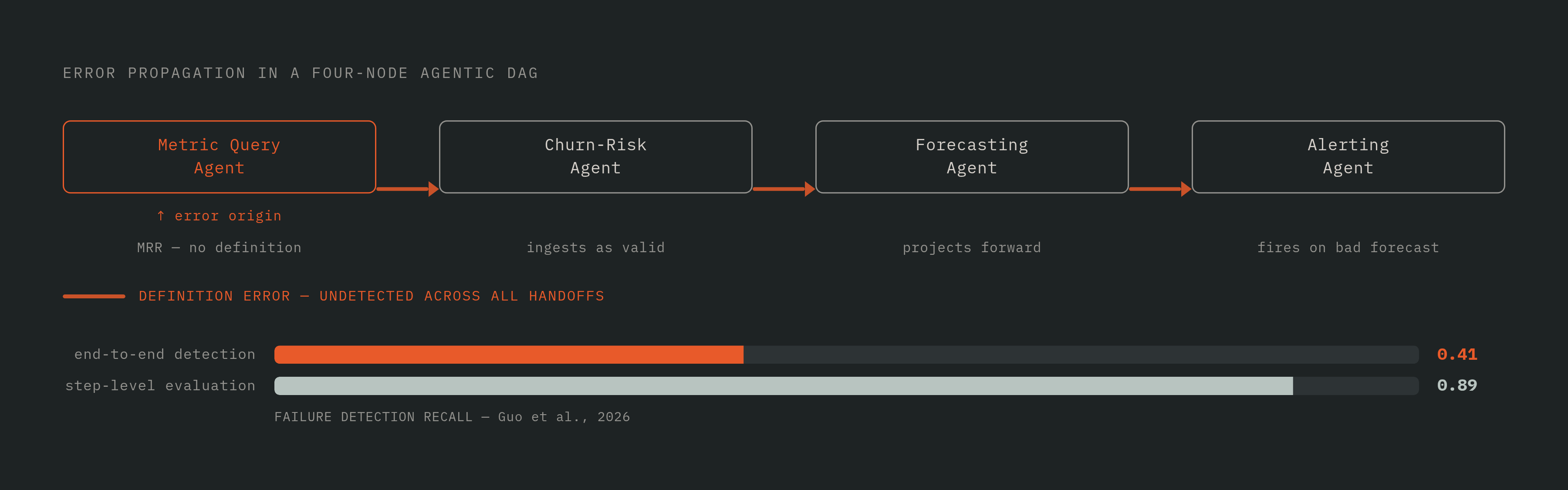
AgentEval (Guo et al., 2026) formally documents how errors propagate through DAG-structured dependencies in agentic workflows. An upstream failure can affect every downstream node that depends on it. In the metric case, a miscalculated revenue figure can become an input to a churn-risk agent, whose recommendations then rest on the corrupted premise. The defect has become part of the reasoning used by later steps, potentially before any human sees an output.
The supervisor-plus-worker pattern makes this problem particularly clear. A coordinating agent may assign a metric query to one specialist and a forecast to another, even though they hold different implicit definitions of the same metric. Coordination does not itself reconcile those definitions. Without definition authority, the supervisor has no mechanism for identifying the inconsistency, and context trimming can further remove whatever definition state a worker held. A team with reporting, forecasting, and alerting agents may consequently operate on three different versions of one KPI rather than gain three checks on a shared calculation.
Why connecting agents directly to production Postgres accelerates the problem on Supabase
Direct production access lets agents move from a business question to executable SQL without passing through a governed metric definition. Broad credentials make this path convenient. They also remove a point at which the team would otherwise have to decide what agents should consume and what those datasets mean. On Supabase, that semantic gap comes with risks to operations and security, so a query that runs tells the team especially little about whether the setup is sound.
Each Postgres connection is a forked process with its own memory, and concurrent agent workflows can saturate a connection pool before the application reaches meaningful user scale. Broad service-role credentials also bypass row-level security. An agent using those credentials can reach data beyond its intended scope because technical permission is not the same as approved use. These problems are distinct from metric ambiguity, but direct access exposes the team to all of them through the same query path.
Supabase’s logging architecture illustrates why separation is useful. Its recommended production approach places logging in a different Postgres database or BigQuery. A co-located logging system cannot help diagnose an instance that is itself having issues. The same separation principle applies to analytical queries, which need not run against the database serving the application. Moving those reads removes their need to run on the application database but leaves open how revenue or churn should be calculated.
Supabase Pipelines launched in public alpha before Select 2026, with new destinations introduced in July 2026. It streams Postgres data to analytical backends so queries can run away from production. An agent querying an unmodeled replica still has no definition authority to consult, even though its analytical work has moved elsewhere. The system needs an authority over calculations.
What a definition authority layer must actually do — and what it is not
A definition authority layer is the single place where metric calculations are declared, stored, and served identically to human and agent consumers. A column called “MRR” does not establish what counts toward the number, what is excluded, how upgrades and downgrades net, or at what grain the result is calculated. Those choices must be spelled out before an agent asks for the metric. Otherwise, the label conceals the same interpretive work that previously happened against raw tables.
A dashboard is not that authority merely because people trust its output, and a data warehouse is not that authority merely because it centralizes records. Definitions must live outside any one tool that uses them. A centralized semantic layer makes business context available as a service, allowing the same calculation to power a dashboard and answer an agent query. Claude and a BI chart can then use identical logic rather than independently construct SQL for the same business question.
MCP standardizes how agents call tools and access resources, but it does not establish what a metric means. The same limit applies to REST or a direct connection. If three analysts have different definitions of a conversion event, giving them the same interface cannot make them agree. The agent needs a single human-established definition, with identity, governance, semantic grounding, query performance, lineage, and auditability beneath the interface. Without that foundation, standardized access can accelerate the consumption of inconsistent calculations.
The practical prescription is to model metrics ahead of time and store them as pre-calculated, governed datasets. Consumers query the defined result. This fixes the calculation at modeling time while leaving both agents and humans able to use it. Monday’s and Wednesday’s values may differ as the underlying data changes, but the calculation need not change with the prompt.
How a governed data layer between Supabase and agents stops divergence before it propagates
A governed analytical layer between production Postgres and consumers changes what an agent is allowed to interpret. Instead of deciding how raw records become a metric, the agent queries a metric that has already been modeled. The definition is declared once and inherited downstream. This removes the point at which each specialist would otherwise make its own choices about inclusion, exclusion, and grain. A handoff can still pass a number to another agent, but it no longer requires that recipient to reconstruct the calculation behind it.
Pre-calculated metrics stored as governed Parquet datasets and queried through DuckDB provide this separation. Agents query those datasets. The business calculation no longer depends on session context. Different prompt wording or a trimmed context window cannot silently change the modeled treatment of upgrades and downgrades.
A single MCP server can give agents those datasets as accurate context that is fast and cheap to query, without giving them a connection to production Postgres. Removing that connection eliminates agent-driven production connection-pool exhaustion and service-role row-level security bypass through this analytical path. The governed dataset beneath it also serves the human dashboard and scheduled report, aligning those consumers with the agent by construction. Human review can then assess the interpretation of a shared metric.
The early-governance objection and why definition authority is cheaper to establish before agents diverge than after
The objection to an early metrics layer is legitimate. Before product-market fit, a founder may not yet know which metrics deserve sustained attention, and elaborate governance infrastructure can get ahead of that uncertainty. The pre-agent response is sensible. Metrics should stay simple and be reviewed often, with more machinery added only once the team knows what it needs them for. Human analysts can also surface ambiguity in conversation before a disputed number becomes an accepted basis for action.
Agents change the cost calculation because they can query all the time, keep implicit definitions in context, and pass those definitions downstream before anyone checks the output. Divergence begins with consumption. What a human analyst might raise in a weekly review can remain invisible in an agentic pipeline until a decision has already been made. Retrofitting authority then means addressing not only competing calculations but also the downstream decisions built on them.
The AgentEval study found that end-to-end evaluation achieved failure detection recall of 0.41, compared with 0.89 for its step-level evaluation. That finding covers workflow failures rather than metric definitions in particular, but it backs the warning that final outputs can hide errors in earlier steps. Detecting a governance gap requires deliberate instrumentation rather than an assumption that inconsistent calculations will reveal themselves. Definition authority prevents unapproved calculations from entering the workflow by setting the approved calculation beforehand.
Governance should remain proportionate while definition authority is established before the second agent is deployed. That requires an agreed calculation for the metrics agents will use to influence decisions before a quarterly review that cannot reconcile two MRR figures. The threshold is neither company size nor funding stage. It is the moment the first agent touches a metric that will influence a decision.