Ranking Headless Analytics Backends by Agent Queryability When Your Frontend Is a First-Party Build on Supabase
A ranking of analytics backends by governed, production-safe agent access.
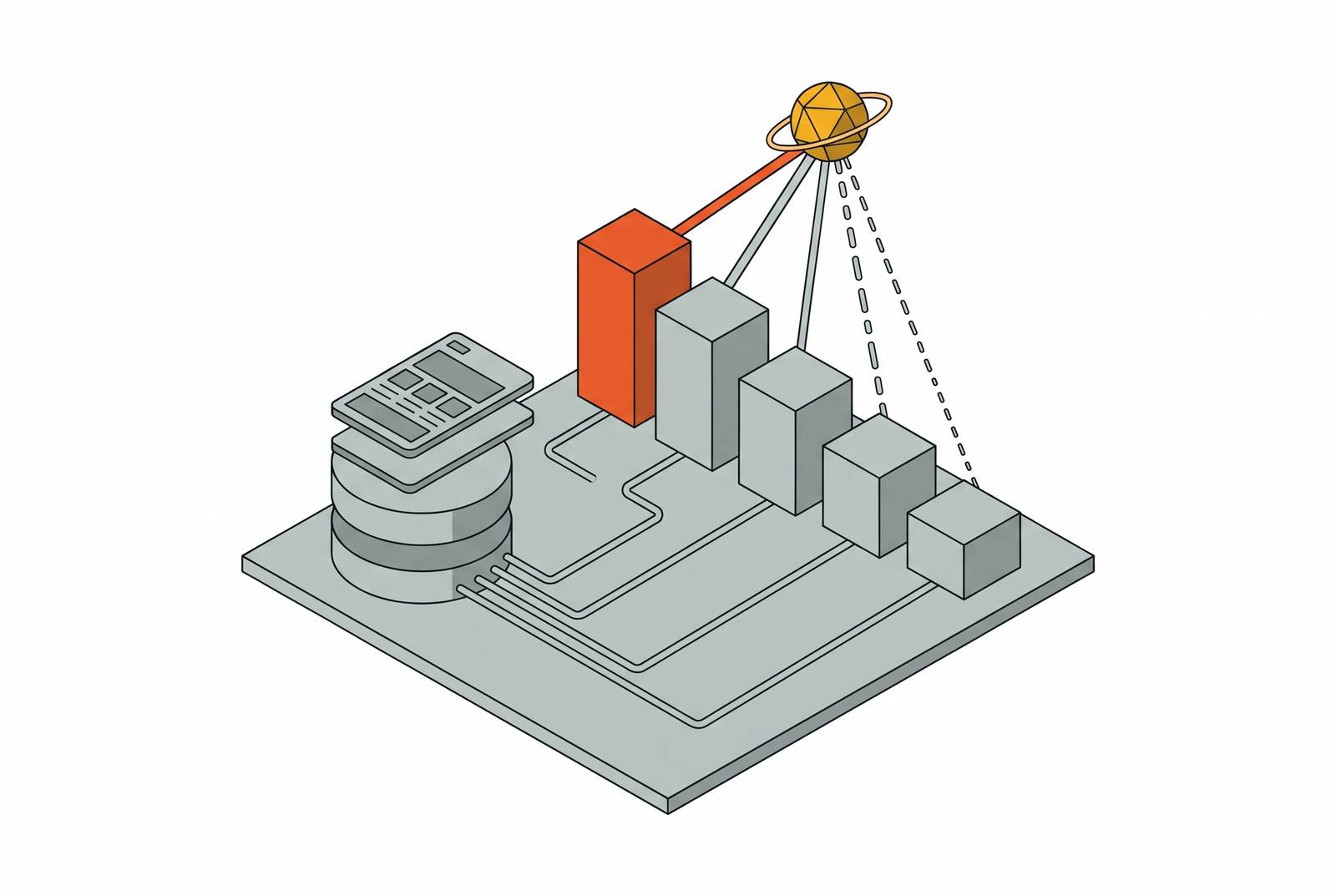
For analytics and dashboards on a first-party Supabase build, the strongest headless backend is one that gives agents governed, pre-modeled datasets without letting them query production Postgres. MCP support is table stakes. The ranking below favors production isolation, versioned metrics, enforced permissions, traceable answers, and semantic state held outside the MCP server.
Why MCP connectivity is no longer the differentiator for headless analytics backends
Every vendor on a team’s shortlist now has an MCP endpoint. Given equivalent connectivity, what separates a backend that returns trustworthy business metrics from one that exposes raw tables through a new interface? Trustworthy business metrics depend on the definitions, permissions, and analytical workload the backend manages behind the endpoint.
Anthropic introduced MCP in November 2024. The 2026-07-28 specification retired protocol-level sessions and formalized statelessness, removing the need for session affinity or shared session storage. Support across Claude, ChatGPT, Gemini, Microsoft Copilot Studio, and Cursor gives backends a shared integration surface. Connectivity alone no longer distinguishes the stronger implementations. Salesforce Headless 360, Informatica, and ZoomInfo GTM.AI all announced or shipped headless MCP capabilities within months of each other in 2026, reinforcing the protocol’s role as infrastructure.
Statelessness makes the MCP server easier to scale horizontally. It does not expand the database’s connection pool. More server instances can still send requests to the same constrained Postgres instance, while ungoverned definitions can disagree no matter how the requests arrive. The useful comparison therefore moves from protocol support to what happens between an agent’s question and the data returned.
What “agent queryability” means when asking “How do I get analytics and dashboards for my Supabase project?”
For a Supabase-native team, agent queryability has three requirements. The agent must stay off production Postgres, resolve metrics against governed schemas rather than guess their meaning, and receive answers traceable to a single auditable definition. A first-party frontend makes those requirements especially important because the analytical interface is not necessarily a vendor’s dashboard. The agent can bypass that dashboard entirely.
Agents querying production can exhaust connection pools, and scaling their MCP server does not increase database capacity. Permissions need their own check because database credentials can let users get past restrictions set only in the application. With Supabase’s row-level security model, that check needs to focus on what the credential actually allows. A governed analytical copy provides a place to enforce access without exposing the production workload.
Raw tables also leave business meaning unresolved. Text-to-SQL can re-derive joins, grain, and calculation logic on every prompt, producing different answers to the same question across sessions. Cube’s headless BI definition supplies the relevant test. An agent must answer a real business question with the right number, under the asker’s permissions, traceable to the definition that produced it.
Supabase’s one-click Grafana Cloud integration, launched in July 2026, and Supabase Pipelines moving to Public Alpha establish useful infrastructure context. Pipelines includes automatic schema change replication, while the Grafana integration supports observability. Neither substitutes for governed business definitions on its own. Their relevance is that Supabase is investing in infrastructure that supports an analytical layer beside production, rather than requiring agents to use production as their analytical engine.
The four-layer architecture every backend must implement, and where most fall short
A complete headless analytics architecture separates four layers. The Data Substrate contains verified, permissioned, refreshable data with documented provenance. The Reasoning Layer holds semantic schemas, governed context, and metric definitions independently of any interface. The Delivery Layer exposes those capabilities through MCP, REST, or GraphQL. The Decision Layer connects the resulting intelligence to an action, a named owner, and an outcome.
These layers solve different problems and cannot substitute for one another. A working endpoint proves delivery alone. Most vendor investment in 2025–2026 has concentrated on that delivery surface, while the meaningful variation sits in the Reasoning Layer. Without governed context, an agent may select a statistically likely but unapproved field. Its answer can look authoritative even when the underlying interpretation is wrong.
Pre-modeled data gives the Reasoning Layer a concrete contract. Metrics are calculated ahead of time and stored as governed datasets, rather than reconstructed from raw tables for each request. Each metric has a named owner, a versioned definition, and a contract the agent can retrieve before querying. That contract needs to live outside the MCP server process. A server that owns semantic state entangles delivery with governance and weakens the separation that a stateless design requires.
A Supabase team should therefore score the backend on five points. Does the backend keep agents off production? Are metrics pre-modeled and versioned, and are access rules enforced before data returns? Is every answer traceable to a definition? Finally, does semantic state live outside the MCP server? These questions distinguish a complete analytical system from a transport wrapper around database access.
Why metric drift and hallucinated business logic are the actual failure modes to rank against
The characteristic failure is a plausible number returned without an error message. One engineer defines revenue as SUM(revenue), while another uses SUM(amount_captured). Both queries can read the right records and still give different figures for Q2 revenue. An agent with raw-table access introduces another interpretation unless a shared semantic layer constrains the calculation. Successful SQL execution does not establish that the answer means what the business intended.
ARR exposes the organizational consequence of that ambiguity. When sales, finance, and product maintain different definitions, the executive team spends its decision-making time arguing about numbers. Adding agents brings more queries without adding knowledge of how the business works. An agent cannot reliably infer which department’s interpretation is approved merely because the relevant records are available. Without that context, it can generate a confident answer from the wrong business logic.
The calculation requires joining active subscription records, accounting for grace periods, and excluding trial accounts. To an agent querying raw tables, “churn” is only a string unless the backend supplies the definition. Syntactically correct SQL can join the wrong tables or apply incorrect filters. A more capable model does not supply an absent business contract.
Tests and contracts must pass before a dataset becomes available through MCP, rather than appearing in a policy document that the query path never consults. This distinguishes governed access from instructions asking an agent to behave carefully. Validation determines what the agent can consume, while the semantic layer determines what the resulting number means.
The safe access pattern that high-scoring backends share
A governed analytical copy sits behind the MCP server. It separates agent requests from production while making approved metrics available through a controlled interface. Pre-calculated Parquet datasets queried through DuckDB are one implementation of this pattern. Agents discover available datasets and request them by name instead of generating unrestricted queries against production Postgres. The copy serves as both a workload boundary and a consumable form of shared definitions.
Access policy belongs at that same boundary. Row- and role-level rules determine which metrics and records an agent can receive, regardless of the LLM making the request. Those rules apply before data leaves the layer. Pre-calculated datasets also make analytical queries cheaper to run and keep the queries that agents send off the production connection pool. Constrained access helps keep costs predictable as consumption shifts from human analysts to agents.
Each metric has a named owner and a versioned definition, so a change to net revenue has one accountable person and one place to be made. The MCP server only wires access to those datasets. Semantic state lives in the metric catalog and governed data layer. This separation lets the delivery service scale without becoming the authority on business logic.
MCP Resources expose governed datasets, Tools run constrained operations, and Prompts codify repeatable analytical workflows. Teams should start putting this pattern in place before they connect. They should list every source, set row- and column-level policies, give access through a governed protocol layer rather than direct database credentials, and audit every agent query.
Ranking the backends by the five criteria
For a Supabase-native team without a separate warehouse, the governed analytical-copy architecture ranks first against this rubric. Agents query pre-calculated Parquet datasets through DuckDB, with no agent query reaching production Postgres. Named owners and versioned definitions satisfy the pre-modeling criterion, while row- and role-level enforcement governs access before results leave. Answers trace to governed datasets, and semantic state remains outside the MCP process. This architectural ranking leaves open whether any given backend offering Parquet or DuckDB implements all five controls.
Cube comes next for teams that need embedded analytics and strong multi-tenancy. Its data model holds semantic state outside the MCP server, and its governance and row-level security address definitions and permissions before data returns. Its grounded-answer test also directly addresses traceability. CubeStore pre-aggregations cut down on repeated full scans and ease the load on the database beneath them. Production isolation is only partial, though, because the initial aggregation still uses the source. Supabase teams must assess that workload against their connection-pool limits and manage pre-aggregation schedules accordingly.
The dbt Semantic Layer with MetricFlow follows for Supabase teams that have not separated analytical execution from production. Metric definitions are written in YAML, version-controlled with dbt models, and compiled into native SQL pushed to the connected warehouse at query time. Versioning and definition traceability are strong. The dbt MCP server provides access while semantic state remains outside that server, but query-time calculation does not meet the stricter requirement for pre-calculated datasets. If the connected analytical store is production Postgres, push-down still sends analytical queries to the production connection pool.
That placement changes with the team’s existing architecture. For a team already invested in dbt and using a separate warehouse, the same approach is a stronger fit because analytical execution is separated from production. Access enforcement needs to be checked before it gets a score. The supplied implementation details establish versioning, traceability, and external semantic state, but do not establish every permission control.
Informatica IDMC headless is an enterprise governance option rather than a practical leader for Supabase-native startups. It is strong in lineage, governance, and built-in data quality contracts. Those capabilities address traceability and validation, but they do not alone establish production isolation or pre-calculated product metrics for a Supabase deployment. There is no Supabase-specific integration path in this comparison. Its enterprise-scale architecture and operational investment are mismatched to founding-stage teams, even though it demonstrates the broader adoption of governed MCP access.
ZoomInfo GTM.AI sits outside the ranking for a team’s own product analytics. Generally available June 1, 2026, it has a headless, MCP-native context layer built on verified company and contact data. That is a different dataset and buying decision. Its relevance is the distinct role of governed grounding in an agent stack. Neither enterprise adoption nor MCP-native delivery makes an offering interchangeable with a Supabase analytical layer.
What to look for when a backend claims agent queryability but hasn’t earned it
A buyer should first ask where semantic state lives. The vendor should be able to distinguish the MCP server’s delivery role from the metric catalog’s ownership of business logic. Next, the buyer should ask what happens when two consumers request ARR simultaneously. “Both query the database” is insufficient without a shared, versioned definition governing those queries. Both consumers need to receive the approved calculation even when both requests succeed.
Production isolation needs an equally concrete examination. Can the credentials used by the MCP server reach production Postgres, and can an agent use that path? If so, buyers need to check for connection-pool pressure and the risk that agents can bypass permission boundaries. Buyers should also ask to see metric owners, versioned definitions, and the enforcement of row- and role-level rules. Restrictions that exist only in a UI do not govern a client that never opens it.
The decisive test is a real business question. A team should run it through MCP without touching the UI, compare the number with the governed definition, check row-level permissions, and confirm that the query is auditable. For Supabase teams seeking a warehouse-free design, the evaluation should also establish whether a separate warehouse is required, since that choice adds ETL complexity and schema drift risk. Teams that apply these tests early can give people and agents a shared analytical foundation before plausible but conflicting numbers enter real decisions.