The Pipeline Latency Tax on AI-Augmented Decision Making
Batch pipelines cause AI agents to act on stale data.
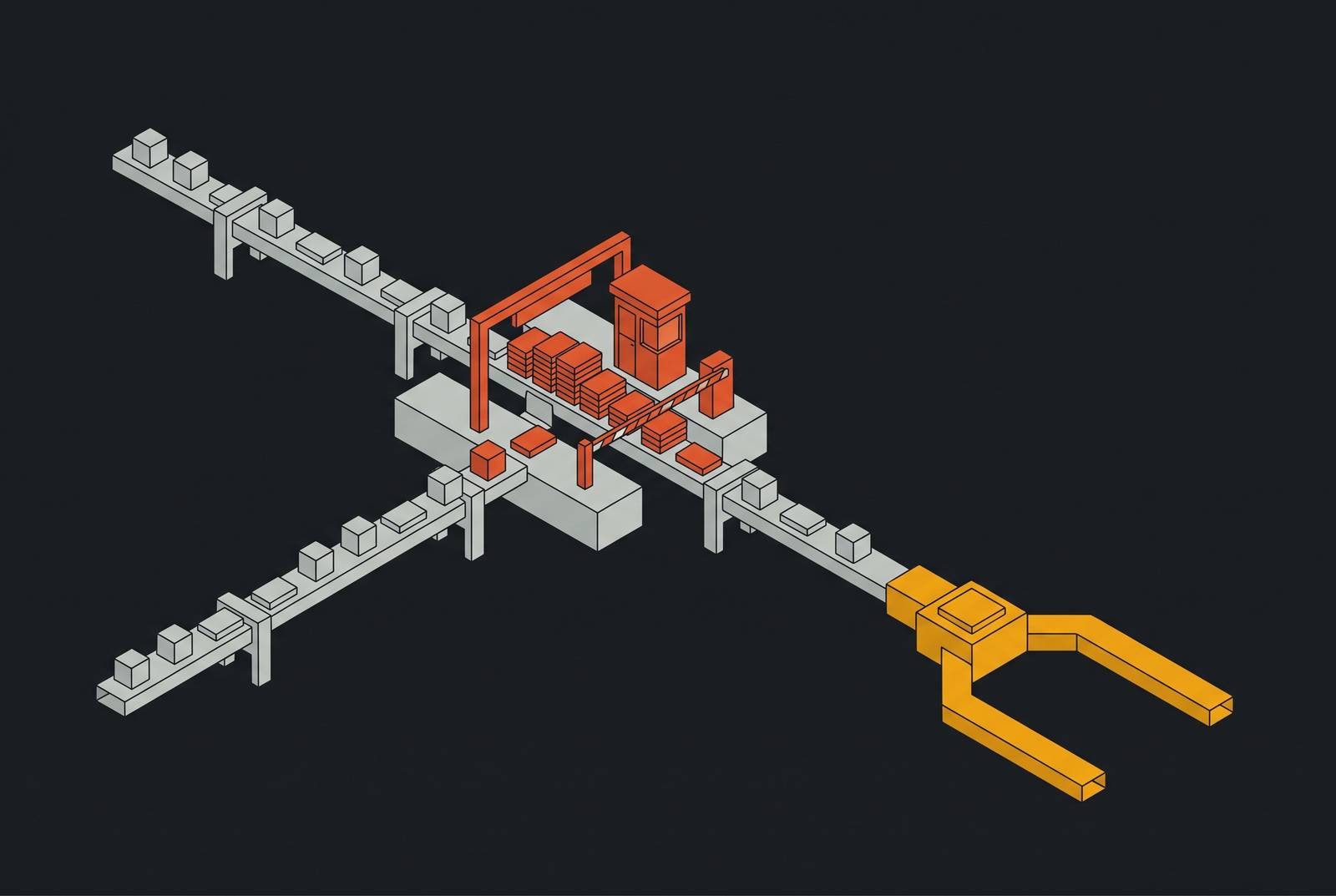
Batch pipelines were built for humans. They serve dashboards, weekly reports, and historical analysis, and their defining assumption is that the consumer waits. AI agents do not wait in the same way, and they do not compensate for latency the way a human analyst does. The result is not slower agents, but agents that reason and act from a version of reality that no longer exists. The only durable fix is to replace batch-oriented access with a governed, pre-modeled data layer that humans and agents consume from the same source.
Why batch pipelines structurally fail AI agents, not just slow them down
The incompatibility is architectural rather than incremental. A human consuming a dashboard tolerates latency, brings context to what the numbers show, and notices when a figure looks wrong. An agent does none of these things. It accepts whatever data it receives as ground truth, and it acts on that data immediately. When the pipeline that feeds it was designed for scheduled consumption rather than continuous reasoning, the agent's behavior degrades in ways that no amount of prompt engineering can correct.
The IEEE Techblog analysis of network operations identifies five failure modes that emerge when agents consume from batch pipelines. They are stale data, memory gaps, delete blindness, schema fragility, and coordination failure. Each represents not degraded performance but qualitatively wrong behavior. Stale data is the sharpest example: an agent diagnoses an outage using telemetry from five minutes prior, by which point the network state has already changed. The remediation it applies to a past state can worsen the current incident rather than resolve it.
Memory gaps strip away the sequence of events that preceded the current moment. An agent cannot tell whether an anomaly is isolated or the third occurrence of a pattern that is degrading over time. Delete blindness follows from ETL comparing snapshots rather than transaction logs. A record that disappears between cycles is invisible to the agent, which continues reasoning as if it still exists. Schema fragility and coordination failure follow the same logic. The pipeline was built for scheduled consumption, not for a process that reasons continuously and acts immediately. A system of that kind cannot tolerate a pipeline between itself and the information it needs.
How the latency compounds across every decision an agent makes
A single stale query is a bug. Stale data baked into every decision cycle is a structural cost, because each downstream action inherits the error of the upstream data. Agents that act on their own outputs amplify the error further, and the sequence compounds with every step in the chain. This is the mechanism that turns latency into a tax: it is levied not once per query, but once per decision, on every decision the agent makes.
Data fragmentation compounds the problem before an agent ever sees a number. When information lives across product databases, payment systems, CRMs, and spreadsheets, integration lag stacks on top of pipeline lag. The agent does not experience these as separate delays. It experiences them as a single, cumulative distance between the moment data was created and the moment the agent can act on it. The latency-parallelism trade-off sharpens the cost further. A five-stage sequential pipeline can be up to five times slower than a parallel equivalent under ideal conditions, though real-world speedups are typically lower. Most enterprise pipelines were not designed with parallelism in mind, which means the theoretical ceiling on improvement is rarely approached in practice.
Who pays the tax most — and why startups and small teams pay it at a rate enterprises can absorb
Large enterprises have dedicated data engineering teams that partially paper over pipeline latency. They can afford the headcount to monitor, tune, and rebuild pipelines as agent workloads impose new demands. Startups and lean teams have no such buffer. Every agent decision runs directly on whatever data happens to be available, and no one owns the task of making that data better.
The typical startup data reality is metrics scattered across a product database, a payment processor, a CRM, and spreadsheets. There is no single source of truth and no pipeline owner. Agents query whichever system is easiest to reach, and the result is metric disagreement at exactly the moments decisions matter most: weekly reviews, board calls, agent-triggered actions. Different stakeholders and agents work from different numbers because no governed layer exists to arbitrate.
Startups building on Supabase and Postgres are specifically exposed. Databricks co-founder Reynold Xin's framing, that agents need the underlying infrastructure out of the way to move fast, applies at full force when there is no infrastructure team to manage that infrastructure. The broader deployment picture confirms the cost. Most organizations exploring agentic AI have not yet reached production-readiness, and data quality and readiness are cited as a primary bottleneck. The tax is being paid before agents even reach the decisions they were deployed to make.
Why giving agents direct database access does not solve the problem and creates a new one
It is understandable to want to solve pipeline latency by giving agents a live database connection. It does eliminate the pipeline, and it does remove the staleness that comes with it. But it substitutes a latency problem for a safety and correctness problem that is harder to recover from.
The "God User" problem is the clearest expression of the risk. When an LLM-based agent is given a connection string with read/write access to production tables, a non-deterministic process receives effective administrative access. A wrong query mutates or destroys data with no rollback path. Application-level hooks are insufficient as a substitute, because they provide logging or guardrails after the database role is already permissive. They do not replace a read-only, governed connection enforced at the role level.
The Supabase production-mistakes taxonomy makes the stakes concrete. Missing indexes on foreign keys, queries that bypass Row Level Security by accident, migrations that lock tables, connection pool exhaustion from concurrent agent requests: agents hitting production amplify every one of these. Row Level Security enforced at the database layer limits exposure when an API layer fails, but complex RLS policies become a hidden performance tax at the scale AI agent workloads generate. AI applications frequently issue multiple concurrent database interactions per request, which increases pressure on connections and memory in ways most small teams never anticipated before agents entered the stack.
What a governed, pre-modeled data layer actually does differently
The right response to pipeline latency is not faster pipelines or raw database access. It is eliminating the pipeline for analytical consumption by pre-modeling metrics into governed datasets that agents and humans query from the same source. Pre-calculation is the key mechanism. Metrics computed ahead of time and stored in a format agents can consume cheaply, columnar Parquet queryable via DuckDB, cost a fraction of what live production queries cost. Converting data from row to column format typically compresses it more than 10 times, per a 2026 analysis. And the metrics are always consistent, because they share a single definition.
The semantic bypass risk is the sharpest agent failure mode that an interface layer alone does not fix. If an agent gets direct table access without semantic context, it guesses at metric definitions. A governed layer provides the metric contract, allowed dimensions, and query provenance that make the answer auditable. Separation of workloads matters at the database level as well. Postgres is a transactional engine, not a warehouse. Once analytical queries scan hundreds of millions of rows, transactional latency degrades for every other user and process. The governed layer enforces this separation without requiring a separate warehouse.
Databricks' announcement of LTAP and Lakehouse//RT at the Data + AI Summit in June 2026 reflects the same architectural principle at enterprise scale. Data is stored once in open formats like Delta and Iceberg, transactional and analytical workloads are served from the same copy, and the ETL layer that introduced latency is eliminated. As Reynold Xin described it, "The agents really prefer a much simpler stack, because they can move way faster." Supabase introduced Analytics Buckets built on Apache Iceberg for exactly this separation. Large analytical datasets are offloaded from Postgres into queryable analytical storage, keeping the transactional database lean while enabling time-travel queries.
How MCP connects agents to a governed data layer without session state becoming a new bottleneck
MCP's value is as an interface layer, not a data platform. It standardizes how agents call tools and access resources, but it does not replace the governance, semantic grounding, query performance, lineage, and auditability that the data layer underneath must provide. The original MCP protocol required persistent state, handshakes, and session pinning. These stateful transports broke cloud-native scalability and reintroduced a form of latency at the protocol level, which undermined the very goal the interface was meant to serve.
The July 28, 2026 MCP specification update removed transport-level session management entirely. A remote MCP server can now run behind a plain round-robin load balancer, route on an Mcp-Method header, and let clients cache tools/list responses. The sticky-session requirement that had made horizontal scaling expensive is gone. Statelessness does not eliminate context requirements, however. Each tool call still needs user identity, permissions, the current task, approved datasets, and audit correlation. These move from the session layer into the request itself, which is where a governed data layer enforces them.
A properly designed MCP analytics server provides what direct database access cannot. The agent retrieves a metric contract, asks for allowed dimensions, runs a governed query, and receives a response with provenance. The answer is auditable end to end. The NSA flagged in a May 2026 report that MCP's rapid proliferation has outpaced the development of its security model. That reinforces the point: MCP alone is not a governance solution. The governed data layer is what makes MCP safe to deploy at scale.
What one shared metric definition does that no dashboard feature can replicate
The latency tax has a semantic dimension that faster pipelines cannot fix. If two agents, or one agent and one human, compute the same metric from different queries, the disagreement about the answer is structurally identical to the disagreement that stale data produces. Both corrupt the decision. Metric contracts, a single pre-calculated and named definition of a KPI with specified dimensions, filters, and update cadence, are what enforce consistency. A dashboard that renders from the same governed dataset as the agent eliminates the definition drift that causes number disagreements in weekly reviews.
Pre-calculated metrics pushed to where people work, in an inbox, Slack, or scheduled reports, rather than pulled on demand by whoever remembers to check, close the last gap. The metric is always fresh, always from the same definition, and available without a query. The agent failure mode this prevents is specific and consequential. An agent that guesses at a metric definition by reading raw tables will produce a number that is internally consistent but semantically wrong. It matches no definition any human stakeholder would recognize, which makes the output unauditable. Boards and investors require numbers that are reproducible and traceable to a definition. A governed pre-modeled layer makes a startup's metrics board-ready without a data team, because the model is the team.
How Supabase teams can stop paying the latency tax without adding warehouse infrastructure
The objection this section answers is predictable: a governed pre-modeled layer sounds like data warehouse infrastructure, and a small team has no data engineers to run one. The answer is that Postgres is already home. The analytical layer extends from it rather than replacing it. The practical starting point is to separate analytical reads from production writes immediately. Direct agent analytics traffic to read replicas with purpose-specific, minimal-permission database users. This stops the connection pool exhaustion and RLS bypass risks before anything else changes.
Supabase's agent-skills open-source repository packages Supabase best practices, including Postgres, into a format agents can automatically discover and execute. It addresses the most common production mistakes, missing indexes on foreign keys, accidental RLS bypass, table-locking migrations, connection pool exhaustion, and full-table scans hidden behind ORMs, without requiring manual review of every agent query. Analytics Buckets built on Apache Iceberg let teams offload large analytical datasets from Postgres into queryable analytical storage. Time-travel queries become available, the transactional database stays lean, and there is no ETL to manage.
The result is that the latency tax stops compounding. Agents are not guessing at stale tables, not burning production connections, and not producing numbers that disagree with what the dashboard shows. One governed layer serves both humans and agents, and the decisions they make inherit the same definition of truth.