The Agent-Readiness Gap in Modern BI Tools
Most AI agents fail in production due to data access and governance gaps, not reasoning limits.
The bottleneck blocking agentic AI in production is almost never the foundation model's reasoning. The obstacle to most enterprise AI agents making it past the pilot stage sits in the data access layer underneath them, not in the model on top. A human analyst carries institutional memory built up over months: which reports are current, which fields nobody trusts, which source actually owns the revenue number. An agent has no colleague to ask. People also tolerate ambiguity with judgment: an analyst unsure which "revenue" column to use will flag the guess or go ask. Upgrading the model or adding more compute does nothing to fix this, because a faster or smarter reasoning engine still won't know which datasource holds the answer, what a given column actually means, or which numbers it has permission to touch.
The three structural failure modes that BI architecture produces for agents
Dashboard-first BI architecture produces three specific, repeatable failure modes once agents try to consume business data on their own, and all three trace back to design decisions, not bad luck. The first is semantic ambiguity with no mechanism to resolve it. Agents have no such fallback, so they guess, and a wrong guess propagates at machine speed across every downstream decision that depends on it. Closing that gap requires handing the agent table definitions, ownership, freshness, and access rules as structured context before it ever runs a query, something a conventional dashboard layer was never built to supply.
The second failure mode is governance that exists at the application layer but not at the data layer itself. Permissions bolted onto an AI application rather than enforced wherever the data actually lives leave a gap agents can walk straight through. An agent that inherits a user's full privileges instead of receiving least-privilege, task-scoped access becomes a single point of failure the moment it is connected to more than one enterprise system, because agents are non-deterministic and move through data far faster than any human can monitor in real time.
The third failure mode is this: there is no identity, lineage, or audit trail built for non-human workloads. Traditional IAM was designed around how people log in: slow, occasional, and easy to review after the fact. Static, credential-centric identity architecture built for slow human actions cannot close a gap that only widens as agents behave more like privileged insiders operating around the clock.
Prompt injection and credential sprawl make the failure modes dangerous
These three architectural gaps stop being abstract once an agent holds real privileges over real data. Prompt injection is the clearest example: agents can execute an entire attack chain autonomously, using their own legitimate privileges to exfiltrate data, because foundational models cannot reliably separate system instructions from ingested data when both arrive through the same context window. Any untrusted text an agent reads has to be treated as a genuine attack vector, not a formatting nuisance. The Five Eyes intelligence alliance, made up of CISA, NSA, ASD ACSC, CCCS, NCSC-NZ, and NCSC-UK, published joint guidance in May 2026 warning that agents capable of taking real-world actions are already deployed in critical infrastructure and enterprise environments without adequate safeguards.
Permission sprawl compounds the risk. Long-lived credentials make the problem worse still. The architectural answer treats the agent as a first-class workload identity in its own right, fronted by an identity gateway that performs token exchange and issues short-lived, just-in-time credentials scoped to a single task. Traditional IAM and PAM systems were built for human login patterns: slow, auditable, bounded by role. They cannot structurally govern an agent firing off high-frequency autonomous actions without a centralized broker translating intent into deterministic, ephemeral authorization decisions.
What MCP standardizes and leaves unsolved
MCP has become the common connective layer between AI agents and data platforms, and that is a genuine advance. Treating it as a complete governance solution is a category error with real consequences, because the protocol standardizes the interface but not the semantics or security that the interface runs on. Standards like MCP give agents and enterprise data platforms a shared way to talk to each other, but governance still depends entirely on how each implementation chooses to enforce it. MCP cleanly separates three layers: the AI client, the MCP server handling connector logic, and the resource itself, whether that's a database or an API. As of the 2026-07-28 specification, this separation means any MCP request can land on any server instance without requiring sticky routing or shared session stores, which opens up horizontal deployment patterns analytics workloads actually need.
What the protocol does not supply is identity, governance, semantic grounding, query performance, lineage, cost controls, or auditability. An agent still needs every one of those, and none of them arrive as part of the protocol layer. An agent given direct table access without semantic context will guess at meaning, and an agent given semantic context without query access simply cannot answer. That pattern works well until an agent bypasses the approved semantic layer and calls raw query tools directly, and because MCP sessions are stateless, there's no persistent session to audit across the calls, so that kind of bypass is harder to catch. Whether all of this gets resolved depends on the implementation layer built on top of MCP.
The four components an agent-ready data layer must supply that BI tools don't
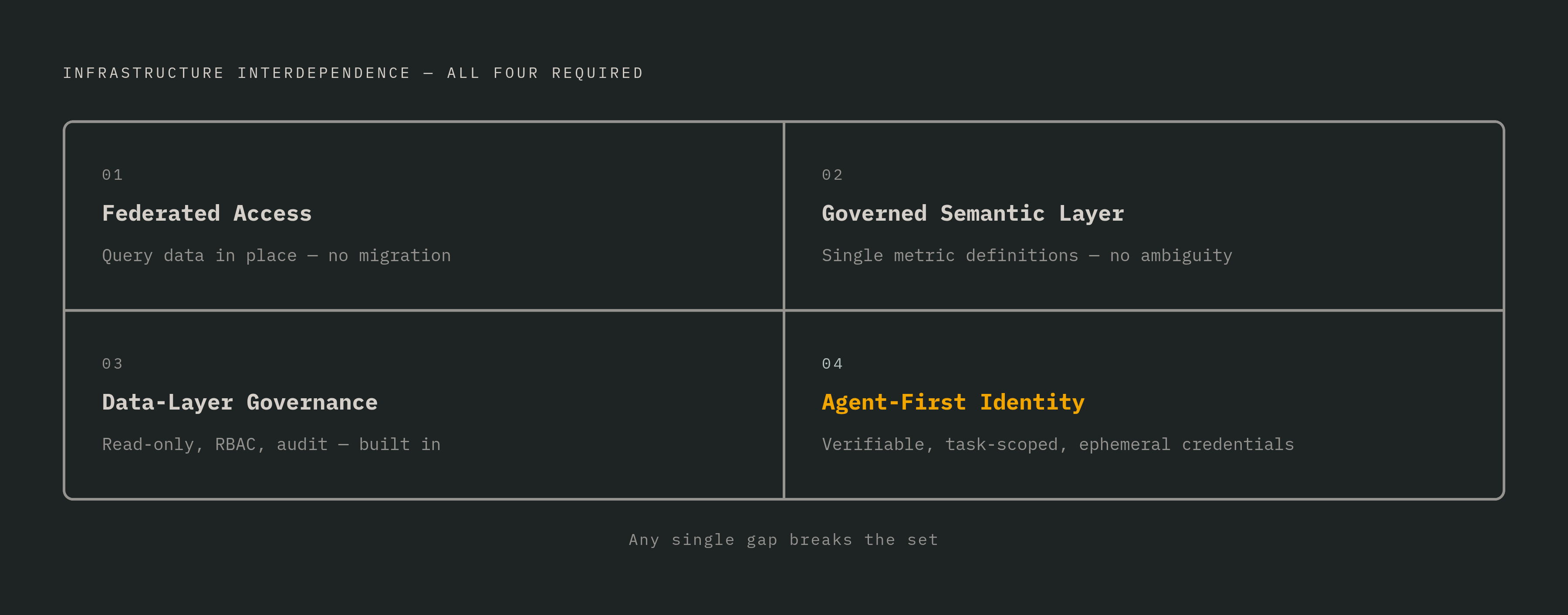
Closing the agent-readiness gap takes four infrastructure capabilities conventional BI tools were never built to provide, and they function as a set: missing any one of them undermines the other three.
The first is federated access that lets agents query data directly where it lives. Centralizing data before agents can use it repeats the data warehouse pattern that has already struggled to keep pace with human analytics needs, let alone agentic ones. It's slow, expensive, and doesn't scale to the number of sources an agent needs to traverse daily. Federated access lets agents query data where it already lives, under the security controls already in place, rather than demanding a migration as a prerequisite to doing anything useful.
The second is a governed semantic layer that resolves ambiguity before the agent starts reasoning. A single definition of a metric, shared across every stakeholder and every agent that touches it, does more for an organization than any dashboard feature could.
The third is governance and permissions enforced at the data layer itself. Read-only enforcement, role- and attribute-based access control, and audit trails need to be built into the access layer from day one, not retrofitted after agents are already running in production. Oracle's AI Database 26ai introduced identity-aware data access control through Oracle Deep Data Security for agentic AI, analytics, and enterprise application workloads, and that signals major database vendors now treat agent governance as core architecture, not a feature bolted on later.
The fourth is agent-first identity: verifiable, task-scoped, and ephemeral. Every AI agent should carry a verifiable identity with permissions scoped to the task in front of it, rather than inheriting a user's full privileges wholesale, so every action it takes can be authenticated and audited after the fact. Lineage and version control round this out by making results reproducible, so a wrong answer can be traced back to the specific stale or incomplete input that caused it. Very few BI tools on the market today satisfy all four of these conditions at once.
How Supabase and Postgres teams encounter this gap specifically
Supabase teams run into a concrete, narrower version of this gap. Postgres is an excellent application database and a genuinely capable analytical substrate, but you didn't get an analytics ceiling or a governance model built with autonomous agents as first-class consumers. Supabase has released a collection of rules for AI agents covering query performance, connection management, security and row-level security, schema design, and concurrency and locking, among other categories. These rules complement the Supabase MCP server: the server handles database connections and execution, while the rules teach the agent judgment the protocol itself doesn't provide.
The problem these rules exist to address shows up constantly in practice. There's also a ceiling to what Postgres alone can carry. It handles application analytics and millions of rows of event data well when you set up indexes properly, but if columnar warehouse workloads grow to larger scale, you typically need a separate warehouse or an agent that crosses multiple sources, and both reintroduce the governance and semantic ambiguity problems diagnosed earlier in this piece.
The deeper issue for agent workloads specifically is what happens when an agent queries the production database directly, even through MCP: analytics pressure lands on the same database serving live user-facing requests, with no governed, pre-modeled layer standing between the agent and the raw tables. Dreambase addresses this gap by pre-modeling Supabase data into governed Parquet datasets queryable via DuckDB and exposing all of it through a single MCP server, so agents never touch the production database while still getting fast, accurate, cheap-to-query context. That closes all four requirements from the previous section without ETL, without schema changes, and without standing up new infrastructure.
Agent-ready analytics infrastructure in practice
Agent-ready analytics infrastructure is recognizable by three properties working together: agents query pre-modeled datasets, governance is enforced in the data layer, and humans and agents draw from the same governed numbers. The right unit of analytics in this kind of environment is a modeled, pre-calculated dataset that both humans and agents can consume safely, because pre-calculation moves the work of resolving ambiguity out of the agent's reasoning loop and into the infrastructure, where it belongs. A dedicated context layer grounds agents in shared business meaning before reasoning starts, and governance lives inside the access layer itself, with read-only enforcement, role- and attribute-based access control, and audit trails built in from the start.
One concrete signal this is working: a single definition for every metric, shared across every stakeholder and every agent, so finance and product never end up arguing over whether MRR is one number or another. The right architecture prevents that kind of inconsistency by design, treating it as a governance failure to be built out from the start. One governed data layer ends up serving both the autonomous agent and the founder reading a morning summary.
Databox offers one signal of where the market is heading. The platform relaunched as an agentic analytics platform in September 2026, with an AI Analyst called Genie as its primary interface, analyzing performance, building metrics, dashboards, and reports, and running recurring analysis through Skills and Routines. Dreambase represents the same architecture applied specifically to Supabase and Postgres teams: a shared data layer serving human teammates and AI agents at the same time, with pre-calculated metrics and governed datasets exposed through a single MCP server, no ETL, no schema changes, no exposure of the production database, and no separate data warehouse required.
The objection worth taking seriously: does pre-modeling data create its own rigidity?
The strongest objection to a governed, pre-modeled data layer is that it trades one failure mode for another: semantic chaos for rigidity. If an agent can only reach pre-approved metrics, a skeptical reader has to ask what happens when the business question in front of it doesn't fit the pre-built model.
The risk behind that objection is real in a specific, technical sense. Agents may call raw query tools instead of the approved metrics layer, undermining the governance the whole architecture depends on, and stateless MCP sessions make this harder to catch because there's no persistent session to audit across the calls. That same looseness compounds a second risk: agents generating many small calls that add up to meaningful infrastructure cost, with no session-level visibility to attribute or cap the total.
The answer to the rigidity objection is not to abandon governance. Pre-modeled datasets should govern the metrics that matter for recurring, high-stakes decisions, while a controlled interface for exploratory queries, with read-only enforcement and full lineage, handles the long tail of one-off questions without ever opening the production database to arbitrary access. Regardless of which architecture a team runs, three guardrails hold the governance model together: locking agents to a curated semantic layer with reviewed metrics and dimensions, requiring human review on the first version of any new output, and logging every prompt-to-SQL pair, scoring a sampled slice for faithfulness, and alerting on drift. That last piece treats the AI analytics layer the way any production LLM system should be treated, with traces and evaluations running continuously to establish trust on an ongoing basis. A governed layer paired with a controlled exploratory interface is strictly safer than raw production database access, for both the rigidity risk and the chaos risk it's meant to replace. Governance is the right principle; the real question is whether a given implementation is flexible enough to apply it without becoming a bottleneck itself. The governing standard stays simple: one definition of each metric, one source of truth, and a controlled interface for the exceptions that don't fit the model yet.
A diagnostic checklist for evaluating whether your current stack is agent-ready
The agent-readiness gap can be diagnosed before a team writes a line of new infrastructure. The four structural requirements this piece has laid out translate directly into questions any technical team can answer about its current stack today.
On production exposure: are agent query workloads hitting the production database directly, and if so, is there a governed, pre-modeled layer available to absorb that load while enforcing access controls?
For Supabase and Postgres teams, the fastest path to closing all five of these gaps without standing up a separate data warehouse or building a new ETL pipeline is a governed data layer that extends Postgres into full analytics capability in place. Dreambase is built to provide that.