Killing the Warehouse Setup Step by Running Agentic BI Pipelines Natively on Supabase Postgres
Precomputed, governed metrics let agents skip the warehouse safely.
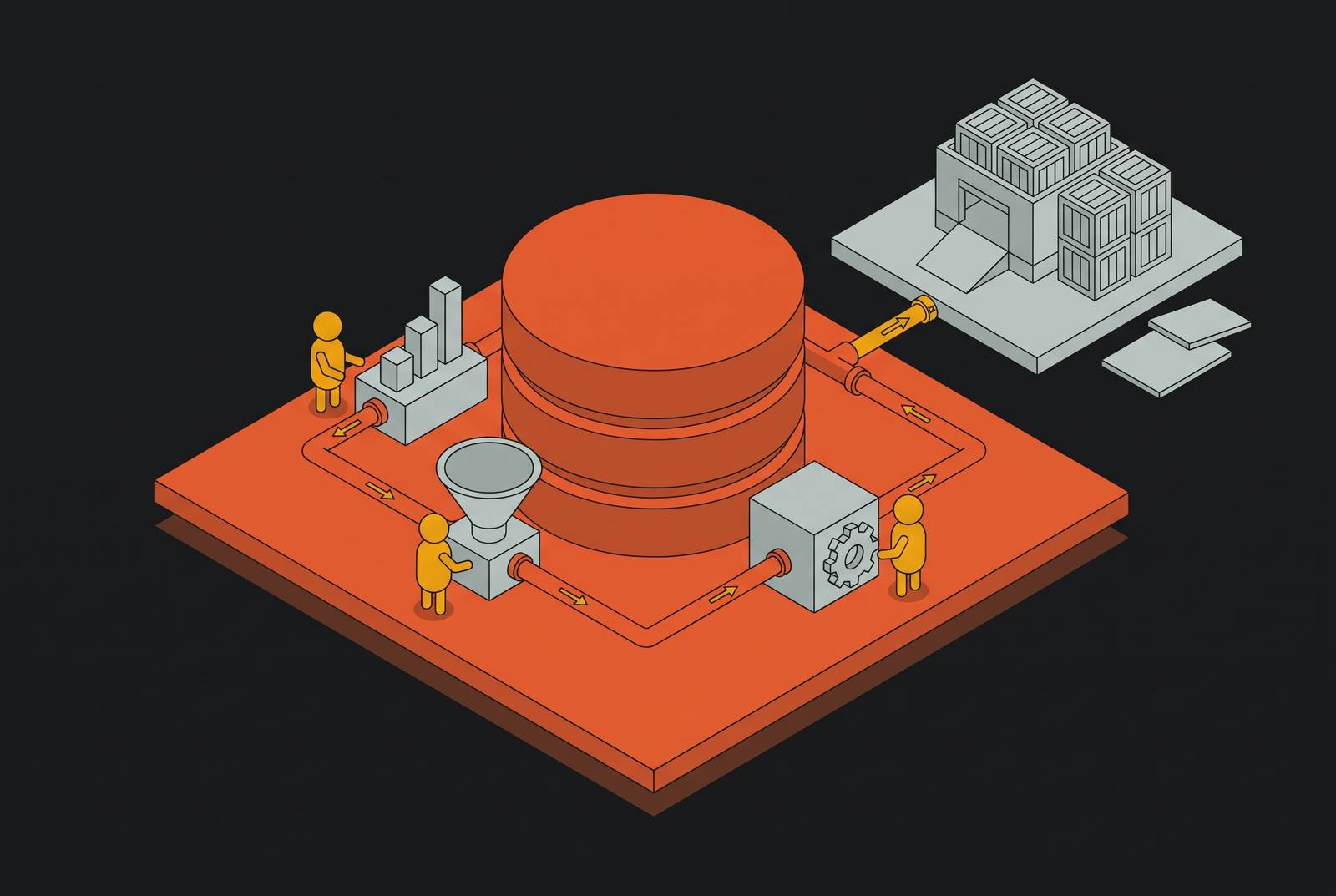
For Supabase teams, analytics and dashboards do not require a separate warehouse when a governed BI layer pre-calculates metrics from Postgres and serves those datasets to humans and agents. This setup skips the warehouse setup step without letting agents query live production rows. Its advantage is separation without a second system of record, with Postgres remaining the source of truth and every consumer using the same metric definitions.
Why analytics was always assumed to happen somewhere other than where the data lives
The operational database serves the application, while another system serves analytics. Extraction becomes the price of admission because the analytical tool expects data to arrive somewhere other than its original home. That arrangement made sense when BI tools could not query transactional databases efficiently and dashboards were the main consumers of analytical output. Over time, a response to those constraints became an assumed prerequisite.
Agentic workflows change what the analytical system must provide. Agents need governed, pre-modeled data on demand, rather than only batch-refreshed dashboards, and an additional warehouse introduces latency and complexity into that access path. For Supabase teams, user activity, billing events, and feature usage already land in Postgres. Their analytical questions begin with that same ground truth. The architecture therefore needs to separate workloads and govern answers, but it no longer needs to assume that doing so requires a separate warehouse.
What running analytics on production Postgres actually costs at scale
Removing the warehouse does not justify unrestricted production queries. Pointing a BI tool or an agent at the Postgres instance serving the application exposes transactional resources to a different workload. Analytical queries keep connections open longer than transactional requests do, so they compete with application traffic for the same pool. Aggregation scans also consume I/O capacity needed for customer-facing reads and writes. Postgres can handle joins and aggregations well at small volumes, which makes this competition easy to overlook until usage grows.
Row-level security policies designed around application access patterns can produce unexpected results when aggregation queries traverse them. An agent with broader credentials than its task requires can also cross permission boundaries that its analytical purpose does not justify. SQL written separately can also define the same metric in different ways. Resource contention, authorization, and metric correctness are distinct problems, even when a single query exposes all three.
Small datasets can conceal these risks for a long time. By the time they become visible, direct database access may already be embedded in dashboards and agent workflows. The distinction is therefore between querying live production rows and operating a governed analytical layer within the Postgres ecosystem. Native analytics must refer to that governed layer, which requires more than a direct connection.
Why the traditional fix — ETL to a separate warehouse — introduces its own compounding cost for early teams
A separate warehouse keeps workloads apart, but it adds work before many early teams know which metrics they need to track over time. Engineering time goes into a pipeline whose purpose is still being discovered. Connectors, a transformation layer, warehouse compute, and a BI tool become parts of the operating burden. For a solo founder or generalist engineer at seed stage, that stack can be disproportionate to the analytical need.
Maintenance then compounds the initial setup cost. Failed jobs require retries, and schema drift requires investigation, with more pipeline complexity creating more opportunities for repair work. A data engineer hired before volume justifies the role becomes an expensive response to an unresolved design question.
The extra system also introduces a reconciliation problem. Data goes through extraction, transformation, and loading before consumers can use it, and each step adds latency. The warehouse holds another version of the data that must stay in line with Postgres, with the same metric definitions in both. A system intended to establish consistent answers can therefore introduce another place for them to diverge. For early teams, the alternative must preserve workload separation without recreating this entire chain.
How pre-calculating governed metrics on Postgres collapses the extraction assumption
The warehouse’s essential function here is separation. It keeps analytical requests away from production compute and provides a governed place for metric definitions. Those functions can be delivered by calculating metrics before consumers request them. Raw events and records still land in Postgres, and a governed BI layer turns them into analytical output. The separation occurs between calculation and consumption.
On a governed schedule, the layer reads from Postgres, applies defined calculations, and materializes the results as governed datasets. Those datasets can be Parquet files queryable through DuckDB, outside the production connection pool. At analytical time, a dashboard or agent queries that prepared output. Consumer queries therefore do not contest production I/O. The scheduled preparation still reads production data, but it is a bounded operation rather than an open-ended stream of analytical requests.
Definitions are applied before the dataset reaches a consumer. One engineer’s SUM(revenue) and another’s SUM(amount_captured) no longer become competing answers simply because each wrote independent SQL. The governed calculation sets which definition is used, and dashboards, agents, and Slack reports all read the result. This is the precise sense in which the architecture is native to Postgres. It removes the separate warehouse extraction pipeline, not every read or materialization of data, and its freshness depends on governed recalculation rather than synchronization with another system of record.
Why MCP makes this architecture addressable by agents without opening production access
Without a shared interface that agents can use to find and request datasets, the governed layer is useful mainly to dashboards and tools that people run. Anthropic introduced Model Context Protocol, or MCP, in November 2024 and donated it to the Agentic AI Foundation under the Linux Foundation in December 2025. MCP provides a common integration surface, replacing N×M point connectors with N+M implementations. A single server can expose governed datasets to compliant agent runtimes.
The stateless revision finalized on July 28, 2026 simplifies that serving architecture. It removes protocol-level session tracking and places client identity and capabilities in a _meta parameter with each request. A remote server can then run behind a plain round-robin load balancer without needing sticky sessions or a shared session store. That changes how the access layer scales. It does not, by itself, decide which data an agent should be allowed to consume.
To keep access safe, authorization must stay out of the agent’s hands. Agents discover datasets and request them by name through MCP Resources and Tools, without sending queries to production Postgres. Endpoints sit behind OAuth or JWT middleware, with the hardened authorization specification built on OAuth 2.1 and Client ID Metadata Documents recommended for client registration. Tight scope tokens, per-agent credential isolation, and sandboxed contexts address confused-deputy and prompt-injection risks by constraining access.
Salesforce Headless 360 exposes capabilities through APIs and MCP endpoints, while Informatica announced native MCP support for headless data management at Informatica World 2026. These examples provide context. The Supabase architecture rests on the narrower boundary of agent access to governed analytical datasets.
What the semantic layer does that the protocol layer cannot — making metric agreement part of the infrastructure
Two agents can reach the same tables through the same interface and still answer a business question differently if each constructs its own calculation. The disagreement often becomes visible only when a CFO’s dashboard contradicts an agent’s answer or an investor asks for audited numbers.
The semantic layer moves definitions out of individual queries. “Active User,” “Churn,” and “ARR” are defined once and applied when the governed dataset is calculated. Claude and a CEO dashboard then consume identical definitions rather than independently translating a business term into SQL. Dataset validation also establishes a boundary between prepared analytical input and unverified source data. This grounds the agent’s data access in validated results, rather than treating protocol access as evidence of accuracy.
For Supabase teams, that extends an existing trust relationship. Postgres already holds the product’s ground truth, and the governed layer connects that truth to a common analytical definition. Sales, finance, and product need a modeled dataset for ARR that means the same thing to everyone who uses it for the same board meeting. In an agent-first architecture, that dataset is the unit of analytics.
How do you get analytics and dashboards for your Supabase project?
An agentic BI pipeline begins by monitoring Postgres for schema changes, data quality signals, and freshness, using those signals to decide when governed datasets need recalculation. Its intent specifies what it must produce. Observability identifies the conditions that can prevent the output from remaining useful.
Pre-calculation follows on a governed schedule or after an observed change. The layer reads from Postgres, applies the metric definitions, and materializes the results into governed Parquet datasets. This stage still consumes production resources. Its difference from ad-hoc analytics is that the read is bounded and scheduled, rather than initiated independently by every consumer. The resulting datasets can then serve analytical demand without repeated production queries.
Exposure gives agents and humans access to the same output. A single MCP server makes the datasets available to agents through DuckDB, without a connection to the production Postgres pool. People get the same metrics through dashboards, Slack reports, or email. Each dataset keeps its definition, lineage, and quality history as part of governance along this path. Agents find datasets by name and type, and authorization sets what each context can query.
Schema drift or a data quality failure triggers recalculation or quarantine of the affected dataset, preventing silent propagation of bad numbers. For a Supabase team without a dedicated data engineer, the infrastructure handles pre-modeled metrics, governed access, and agent-safe exposure, which would otherwise take ongoing work to coordinate by hand. Analytics becomes available before the team can justify a data hire.
Why founding teams and AI agents both need the same thing — a single governed number they can trust
Humans and agents may give answers based on different definitions, data that differs in freshness, or different permission contexts, even when all the data came from Postgres. That divergence turns a technical inconsistency into an operating problem. When CAC, LTV, monthly churn, ARR, and gross margin do not reconcile, executives debate the numbers, delaying debate over the decisions. Agents acting on those same disagreements amplify them at speed.
A governed layer should keep the metric list to five or fewer actionable KPIs and enforce their definitions from day one. That avoids accumulating reconciliation debt before investors ask for audited numbers. It also makes the analytical contract explicit for every consumer, whether the result appears in a weekly email, a dashboard, or an agent workflow. The important shared asset is not the interface but the defined number behind it.
This is why the warehouse setup step can become architecturally counterproductive. When governed pre-calculation already separates consumption from production and establishes common definitions, another system of record adds synchronization work. The appropriate architecture follows the required boundary. Postgres supplies the ground truth, governed datasets establish its analytical meaning, and scoped access lets humans and agents use that meaning without reopening production to arbitrary queries.